
Asia-Europe rates fall as Suez returns, Asian congestion hits 4.3 million TEU
For shippers, global fleet capacity may no longer accurately reflect the capacity available on individual trade lanes or at specific ports.
GLOBAL – Asia-Europe container freight rates are declining as congestion at Asian ports prompts carriers to shift more services back through the Suez Canal, according to Sogese’s September Europe Container Market Update.
Drewry’s World Container Index (WCI) on September 3 showed the Shanghai–Genoa rate down 10% week on week to US$4,368 per 40ft container, while the Shanghai–Rotterdam rate fell 5% to US$4,092 per 40ft container.
Blank sailings on the Asia-Europe route are expected to drop from four this week to one next week, signalling a potential increase in available capacity.
Andrea Monti, CEO of Sogese S.r.l, said: “The container market is becoming increasingly fragmented by trade corridor, with freight rates, cargo demand and available capacity moving in different directions across major routes. Asia-Europe rates have started to soften from their mid-year highs while transpacific markets remain firmer, prompting carriers to adjust individual services and vessel deployments rather than manage capacity uniformly across their networks.”
Asian congestion exceeds pandemic peak
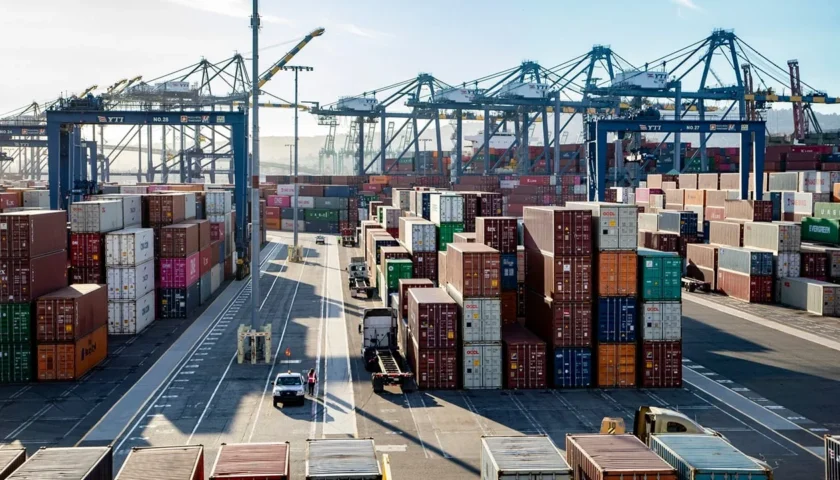
Asian port congestion has reached 4.3 million TEU, according to Linerlytica data, surpassing the 4.0 million TEU stranded at the pandemic’s peak. Cape of Good Hope diversions are absorbing 5% to 7% of global container capacity, roughly 1.7 to 2.4 million TEU.
Meanwhile, MSC, Maersk and Hapag-Lloyd have all announced partial returns to the Suez Canal in recent weeks. Monti noted that the selective resumption of services through the Suez Canal introduces another variable, as shorter voyage times can effectively increase capacity on Asia-Europe routes without requiring additional vessels.
For shippers, global fleet capacity may no longer accurately reflect the capacity available on individual trade lanes or at specific ports.
Route-specific capacity management
Recent service changes reflect a route-by-route approach. Ocean Alliance has revised its CPNW and MTE transpacific services, removing Qingdao, Ningbo and Kwangyang from CPNW in favour of Kaohsiung and Yantian, while MTE will drop Haiphong and add Port Klang.
Maersk’s seasonal TPX service, launched in May to meet peak-season demand between Vietnam, South Korea and the US West Coast, is scheduled to end at the end of the third quarter.
Monti added that the next phase of the market is likely to be shaped less by global supply and demand and more by how and where carriers deploy capacity and cargo.
Sign up HERE to receive our email newsletters with the latest news and insights from Africa and around the world, and follow us on our WhatsApp channel for updates.