Global Food Prices rise again in March as energy costs push up vegetable oils and sugar – FAO
FAO reports global food prices rose in March, driven by higher energy costs, with vegetable oils and sugar leading gains amid supply pressures and geopolitical tensions.
GLOBAL – Global food commodity prices increased in March for the second consecutive month, driven largely by rising energy costs linked to escalating conflict in the Near East, according to the Food and Agriculture Organization of the United Nations (FAO).
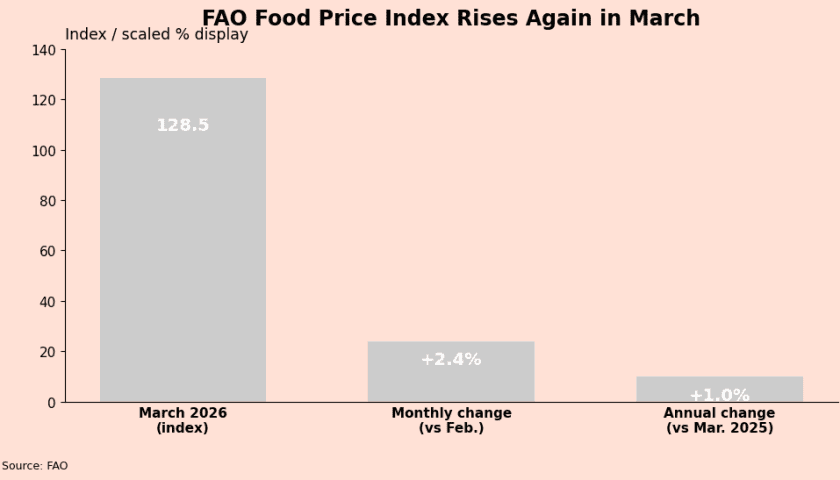
The FAO Food Price Index, which tracks monthly changes in international prices of a basket of globally traded food commodities, averaged 128.5 points in March. This represents a 2.4% increase from February and a 1.0% rise compared to the same period last year.
All five commodity groups monitored by the index—cereals, vegetable oils, meat, dairy, and sugar—recorded price increases during the month.
Vegetable oil prices led the surge, climbing 5.1% to 183.1 points. This marked the third consecutive monthly increase and placed prices 13.2% higher than a year earlier. The FAO attributed the rise to “higher quotations” for palm, soy, sunflower, and rapeseed oils.
Palm oil prices reached their “highest” level since mid-2022, driven by “spillover effects” from rising crude oil prices amid the war in Iran, as well as “lower-than-expected” production in Malaysia, the agency said.
Soy oil prices rose “marginally,” as expectations of increased biofuel consumption in the United States were partly offset by rising exports from South America. Meanwhile, sunflower and rapeseed oil prices were supported by Black Sea supply “tightness” and “stronger” feedstock demand.
The FAO Sugar Price Index surged 7.2% to 92.4 points, reaching its “highest” level since November, although it remained 21% below the level recorded a year earlier. The increase was linked to higher crude oil prices, which raised expectations that Brazil may allocate more sugarcane toward ethanol production.
However, the FAO noted that the rise in sugar prices was limited by a “generally favourable” global supply outlook for the 2025/26 season, supported by “good” harvests in India and Thailand.
The cereal price index rose 1.5% from February to 110.4 points, reflecting gains in wheat, maize, barley, and sorghum. However, rice prices declined by 3% due to “harvest pressure, weaker import demand and currency depreciations against the US dollar,” according to the FAO.
The meat price index increased by 1% month-on-month to 127.7 points, marking an 8% rise compared to the previous year. The FAO said the increase was driven by higher pig meat prices and a “modest” rise in bovine meat.
“Ovine and poultry prices softened,” the FAO added, noting that ovine prices declined due to higher exports from New Zealand, while poultry prices fell amid “weaker” Brazilian quotations and ample supply.
Sign up HERE to receive our email newsletters with the latest news and insights from Africa and around the world, and follow us on our WhatsApp channel for updates.