

Hapag-Lloyd resumes upper Gulf bookings via feeder routes, bypasses Strait of Hormuz
The routing also accommodates multiple cargo categories, including dry cargo, reefer shipments, and oversized special cargo.
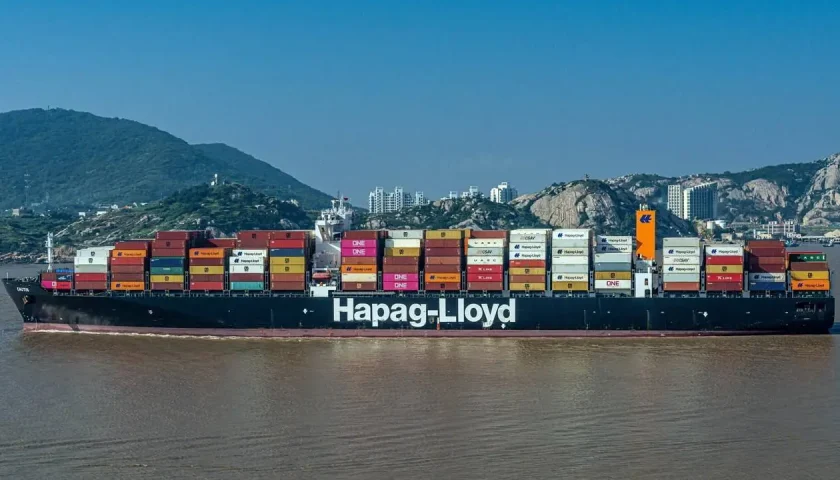
UAE – Hapag-Lloyd has resumed bookings for cargo movements to and from Upper Gulf locations through third-party feeder services, using Sharjah as a transhipment hub to bypass the Strait of Hormuz.
The development enables cargo connectivity between Kuwait and Saudi Arabia via Dammam, Qatar, Iraq, and the United Arab Emirates, while avoiding transit through the Strait of Hormuz.
How the Feeder Network Works
The company stated that the revised routing structure enables cargo to move via Sharjah as a transhipment point for the Upper Gulf. This arrangement is intended to maintain continuity of trade flows under current regional operating conditions.
The routing also accommodates multiple cargo categories, including dry cargo, reefer shipments, and oversized special cargo.
The operational framework covers bonded cargo movements between Sharjah and Khorfakkan, linking these hubs to ports in Oman and India.
Shipments to and from the United Arab Emirates will be managed via Sharjah, supported by bonded trucking services. The company stated that this inland connectivity is key to maintaining cargo flows despite constraints affecting maritime routes.
Transit Times and Alternative Routing
Feeder vessel operations under this model will not follow a fixed weekly schedule and will remain dependent on regional transit safety conditions.
The company added that the lead time for bonded transport between Sharjah and Khorfakkan is expected to be about five days, reflecting adjustments to routing and handling procedures.
The announcement also confirmed that Carrier’s Haulage solutions via Jeddah remain in place, in line with earlier communication issued on 27 March 2026. This provides an additional route for shippers seeking alternatives within the network.
Operational Takeaways
For fresh-produce investors and food traders, Hapag-Lloyd’s revised routing offers a practical workaround to ongoing maritime constraints in the Gulf.
For instance, bonded trucking between Sharjah and Khorfakkan ensures reefer containers maintain temperature integrity during inland transhipment.
Additionally, the five-day lead time for bonded transport enables logistics managers to plan, while the Jeddah alternative provides additional routing flexibility.
Although feeder vessel schedules remain contingent on safety conditions, the resumption of bookings restores trade connectivity for perishable goods moving to and from Upper Gulf markets.
This multi-layered approach, combining feeder vessels, bonded trucking, and alternative hub routing, demonstrates how logistics providers are adapting to regional instability while preserving supply-chain continuity for temperature-sensitive cargo.
Sign up HERE to receive our email newsletters with the latest news and insights from Africa and around the world, and follow us on our WhatsApp channel for updates.