

Kenya Sugar Board orders mandatory registration of sugar repackaging firms
The Kenya Sugar Board has directed all sugar repackaging businesses to register under new rules aimed at improving traceability and quality control.
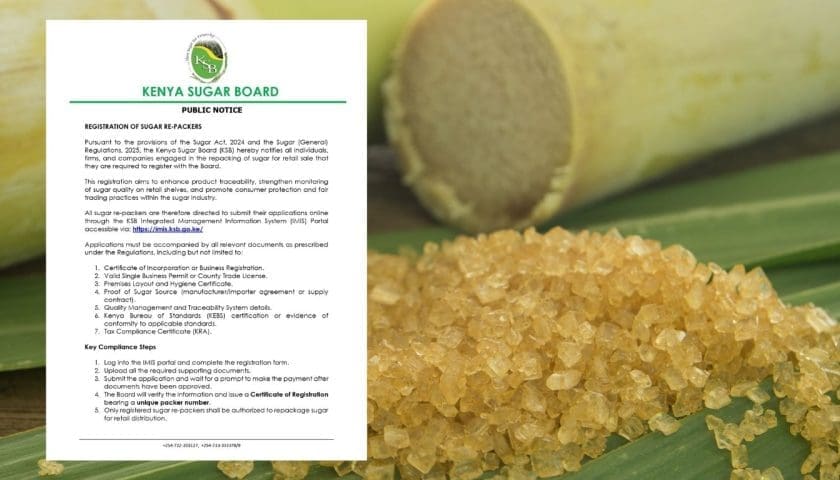
KENYA – The Kenya Sugar Board (KSB) has directed all entities involved in the repackaging of sugar for retail sale to register with the board in compliance with the new Sugar Act, 2024, and the Sugar (General) Regulations, 2025.
In a notice issued by the board, the directive seeks to strengthen the traceability of sugar products, enhance enforcement of quality standards, and protect consumers from substandard or counterfeit products circulating in the market.
According to KSB, all individuals, companies, or organizations engaged in sugar repackaging must apply through the Kenya Sugar Board’s Integrated Management Information System (IMIS) portal.
Applicants are required to submit all relevant documentation as outlined in the regulations and any additional guidance provided by the board.
The announcement comes shortly after KSB launched a nationwide crackdown targeting businesses involved in illegal sugar distribution and sales.
The operation, led by the board’s Product Quality Officer, Joseph Wafula, aims to curb non-compliance within the sugar trade.
“This crackdown is part of the mandate of the Kenya Sugar Board as per the Sugar Act number 11 of 2024. During the operation, some of the goods were seized, and we have already started investigations. Further analysis will also be done,” Wafula stated.
In a related incident, the Anti-Counterfeit Authority (ACA) in August intercepted hundreds of bags of counterfeit sugar smuggled into Kenya from Somalia.
The seizure, made in collaboration with security agencies at the Sabaki Security Patrol Point in Malindi, involved 676 bags of counterfeit sugar, jerricans of cooking oil, and three transport trucks.
Kenya’s sugar sector has faced increasing scrutiny in recent months. In July, Wiper Party leader Kalonzo Musyoka claimed that 25,000 metric tonnes of unfit sugar had been offloaded at the Port of Mombasa and repackaged for sale in Western Kenya.
The Kenya Bureau of Standards (KEBS), however, dismissed the allegations, describing them as “false and misleading.” The agency reaffirmed that all sugar imports undergo rigorous inspection and certification to ensure they meet safety standards before entering the Kenyan market.
Sign up HERE to receive our email newsletters with the latest news and insights from Africa and around the world, and follow us on our WhatsApp channel for updates