
Kenyan macadamia farmers push to lift raw nut export ban amid China deal
A new trade agreement between Kenya and China, set to take effect May 1, offers a potential lifeline.
KENYA – Macadamia farmers and traders in Kenya have renewed calls for Agriculture Cabinet Secretary Mutahi Kagwe to suspend the law prohibiting the export of raw nuts, arguing that restricted market access has led to surplus stock and depressed prices.
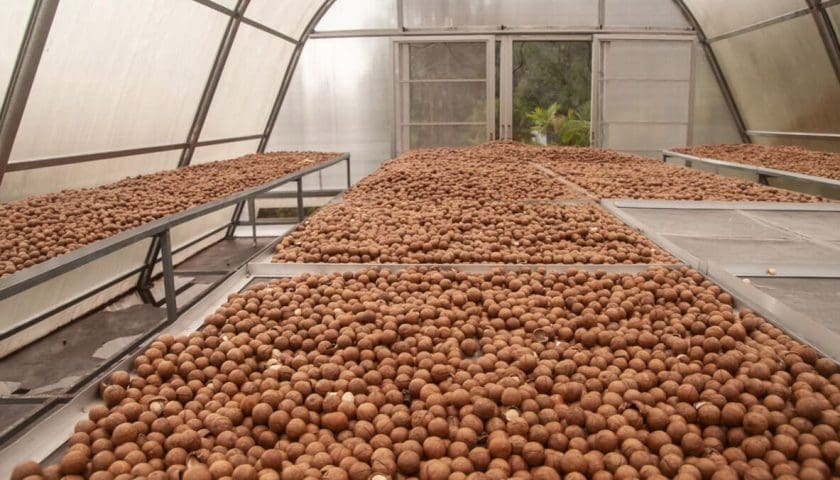
The current regulation allows only processors to export value-added products, primarily to Western markets, while excluding Asian buyers who prefer raw nuts.
Johnson Kihara, chairperson of the Nut Traders Association of Kenya, explained that the policy, which aims to promote value addition, has, in fact, constrained market access. “The CS later said he had found a market in the U.S. He went on a trip to the country accompanied by the chairlady of the Macadamia Association of Kenya,” Kihara said.
“The market, they said, that they secured in the U.S. has not reached the farmer. About eight nut trading companies have now shut down. Farmers have macadamia nuts piled up at home,” he added.
Therefore, liberalizing the market would allow processors to continue exporting processed nuts while enabling traders to export raw nuts, particularly to China, where demand remains strong. This dual-track approach could stabilize prices and improve returns for the 200,000 to 500,000 smallholder farmers who depend on the crop.
A new trade agreement between Kenya and China, set to take effect May 1, offers a potential lifeline. The deal allows duty-free exports of agricultural products, removing the previous 10% to 15% tariffs on macadamia nuts.
Moreover, in 2025, exports of fresh and frozen avocados and macadamia nuts to China reached US$19.9 million, demonstrating existing market appetite that could expand significantly with access to raw nuts.
For investors, rewards lie in Kenya’s position as the world’s third-largest macadamia producer, accounting for about 20% of global supply across 4,488 hectares.
Additionally, Kihara emphasized that revising the regulation would allow surplus volumes to access alternative markets while maintaining processed exports. “If the market is low in the West, there is still a market in China. Doing away with the law will make it possible for farmers to sell their macadamia directly from the farm,” he said.
With production reaching 51,200 tons valued at US$38.2 million in 2024, the sector’s stability hinges on balancing government industrialization goals with farmers’ immediate livelihoods.
The pending China trade agreement offers a pathway to diversify trade routes, provided export restrictions are eased to access it.
Sign up HERE to receive our email newsletters with the latest news and insights from Africa and around the world, and follow us on our WhatsApp channel for updates.