
Kenya’s Tea Industry: Restoring Leadership through Reforms

Kenya is not just known for its wildlife and scenic landscapes; it’s also the world’s leading exporter of black tea. Tea is the backbone of Kenya’s agriculture, contributing approximately 26% of export earnings, 4% of national GDP, and supporting over 600,000 smallholder farmers alongside large-scale multinational estates.
The industry’s structure combines smallholder resilience with several large plantations organised under the Kenya Tea Growers’ Association (KTGA). Over 800,000 growers, many organised under tea factories, form its backbone. The industry is directly and indirectly responsible for employing approximately 6.5 million people, which is roughly 10% of the population.
The Kenya Tea Development Agency (KTDA), a farmer-owned entity, represents more than 680,000 smallholders across 71 factories. It handles processing and marketing for the majority. Larger players, such as Kakuzi Plc and multinational estates such as Browns Plantations, focus on premium grades and exports.
Tea is predominantly grown in the fertile highland regions, where favourable climatic conditions allow for year-round cultivation. The sector is regulated by the Tea Board of Kenya (TBK), which develops, promotes, and regulates the tea industry.
Tea Production
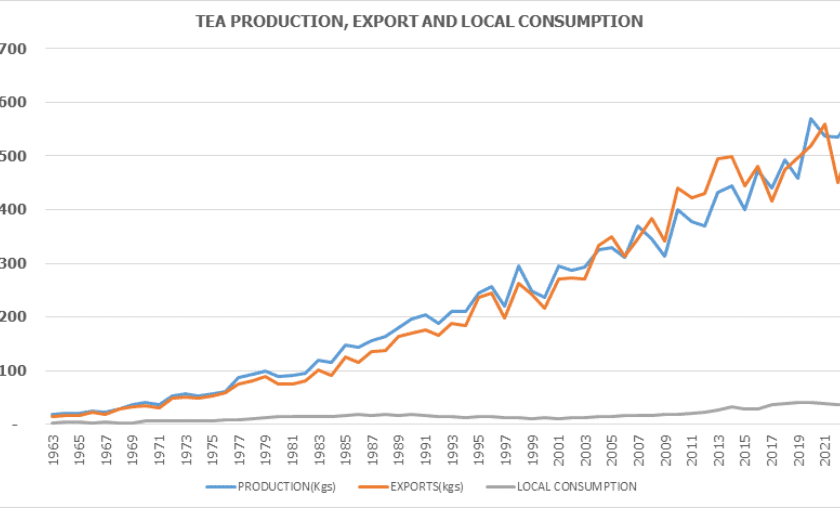
Globally renowned for its high-quality black tea, Kenya ranks as the third-largest tea exporter after China and Sri Lanka. Kenya produced an average of 2.49 million metric tons of green tea and 585,533 MT of processed tea annually over the past six years, ranking it the third-largest tea producer globally, after China and India.
Tea cultivation spans both the eastern and western regions of the Rift Valley, covering approximately 228,400 hectares. The eastern tea zone includes the highland areas around Mount Kenya, the Aberdare Range, and the Nyambene Hills, which together account for roughly 32 per cent of national production. The western region, known for its expansive plains and rolling hills, produces the remaining 68 per cent.
In 2024, Kenya’s green tea leaf production rose by 25.6 per cent from 1.95 million MT in 2019 to 2.69 million MT, driven by favourable weather conditions and the government’s provision of subsidised fertiliser. The most significant growth occurred between 2020 and 2024, with output reaching 2.58 million MT in 2023. These gains were also supported by improved farm-level productivity and favourable input policies.
The country’s high altitude, ideal rainfall, and volcanic soil provide perfect conditions for tea cultivation. This natural advantage gives Kenyan tea its strong aroma and bright colour, making it a favourite in international markets.
The Current State of Kenya’s Tea Sector
Despite being the world’s top exporter of black tea and a critical pillar of Kenya’s economy, the tea industry faces mounting structural, economic, and environmental challenges. One of the foremost threats is a change in the weather. Tea farming in Kenya relies on consistent rainfall and moderate temperatures, particularly in the highland areas. However, changing weather patterns—marked by erratic rainfall, prolonged droughts, and occasional very low temperatures—are affecting both yield and quality.
In 2025, production declined 11.5% in the first seven months to 322.29 million kilograms, largely due to adverse weather across most of the country and cold conditions. The tea growing areas in the East of the Rift were the most affected by adverse weather conditions, which were characterised by minimal precipitation averaging less than 13 mm daily.
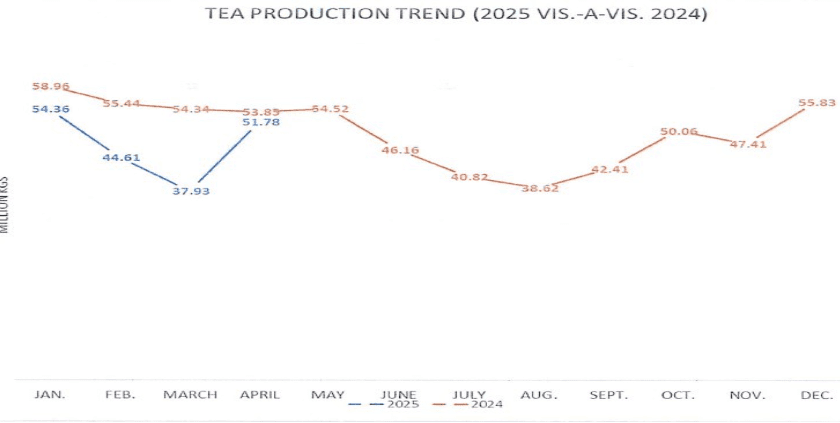
Source: Tea Board of Kenya
Rising production costs also pose a major concern. Key inputs like fertiliser, fuel and labour have become increasingly expensive, with fertilisers alone accounting for a significant portion of operational budgets. Many farmers have cut back on the usage of inputs, compromising both output and quality. Transport inefficiencies, especially in rural areas, and high energy costs further squeeze margins. These cost pressures are undermining Kenya’s global competitiveness, particularly against more efficient producers like Sri Lanka and India.
Farmer dissatisfaction with tea returns is also growing, fueled by delayed payments and limited financial transparency. In 2025, many smallholder farmers under the KTDA expressed widespread concerns about reduced bonus payments. While tea exports generate over a billion dollars annually, a relatively small share of that amount reaches growers. This discontent is prompting some farmers to abandon tea in favour of alternative crops or non-agricultural ventures, weakening the reliability of supply.
The industry is also overly reliant on a small number of export markets. In 2024, over 75 per cent of Kenyan tea was sold to just seven countries: Pakistan, Egypt, the United Kingdom, the United Arab Emirates, Russia, Saudi Arabia and Iran, making the sector highly exposed to geopolitical and economic disruptions.
Recent currency and import restrictions in Pakistan and Sudan have affected trade flows. According to data from the Tea Board of Kenya, exports to South Sudan fell by 12% in 2024, and tea exports to Pakistan fell by 2% due to changes in the sales tax policy. In addition, evolving global preferences for green, herbal, and sustainably sourced teas challenge Kenya’s traditional market dominance.
Lastly, domestic tea consumption remains underdeveloped. Despite Kenya’s production scale, per capita tea consumption is low, with most tea consumed in a traditional milk-sugar blend. Nationally, there is limited awareness or availability of speciality, herbal, or ready-to-drink options. Weak branding, scarce retail innovation, and minimal promotion also constrained domestic growth. However, rising urbanisation and a growing middle class present an opportunity to expand local markets through value-added products and targeted consumer campaigns.
Reviving the Tea Sector
Despite the challenges facing the tea sector, all hope is not lost. The government has announced reforms aimed at rejuvenating the once-glorious sector. To address market challenges, including declining global prices and overreliance on bulk exports, the government has introduced tax reforms and incentives to enhance value addition. The primary objective is to shift from raw exports to processed, premium products. Earlier last year, the government waived taxes on tea packaging materials, which are a major contributor to the high costs of value addition.
Furthermore, the government has launched the country’s first-ever auction for orthodox teas, which fetch higher premiums to boost farmer earnings. This will help the country increase the proportion of value-added tea exports from the current 5 per cent to an estimated 50 per cent.
To increase the visibility of Kenyan tea in international markets, the government has allocated over Kes 1 billion to construct two value-addition and branding centres for Kenyan tea. The government is also working with the French Development Agency (AFD), the French Embassy in Kenya, and Equity Group to support an ongoing feasibility study on Geographical Indications (GI), a tool intended to enhance the global branding and market value of Kenyan tea.
The Agriculture Ministry has also ordered governance and financial audits of underperforming factories to boost farmers’ incomes. This follows reports of mismanagement of funds by tea factory directors and the looting of farmers’ money. Under the reforms, the government has announced a ban on the use of farmers’ funds as collateral for bank loans in a move to protect growers from financial risk and curb the alleged profiteering by factory managers.
KTDA has been directed to close multiple factory bank accounts and operate a single general account to improve transparency and traceability of funds. The ministry is further reviewing the bonus payment model to allow farmers to receive bonuses quarterly instead of annually, aimed at easing liquidity pressures at the household level.
Furthermore, the government is pushing to secure new export frontiers for Kenyan tea beyond the traditional markets. In early 2026, during a meeting with the Kenya National Chamber of Commerce and Industry, Kazakhstan’s ambassador to Kenya, Barlybay Sadykov, proposed establishing a dedicated Kenyan tea and coffee hub in Kazakhstan to facilitate exports to Central Asia. He even outlined incentives to attract Kenyan exporters and traders to the Central Asian market. Kenya also secured duty-free access to export 98% of its agricultural commodities, including tea, to the Chinese market.
Domestically, local manufacturers are brewing innovation to bring export-grade teas to the Kenyan market to increase consumption. Kakuzi Plc recently launched its Kakuzi Pure Black Tea brand for the Kenyan market, seeking to bring export-grade quality to everyday consumers. This forms part of the broader diversification strategy to mitigate risks from volatile international prices by building a robust domestic market.
Prospects for Kenya’s Tea Future
Looking ahead, the future of Kenya’s tea holds immense potential for growth and capitalisation. With global demand for tea projected to surpass 7.4 million tonnes by 2027, the Kenyan tea market stands at an advantage to capture the bigger market share owed to the huge attraction for Kenyan-grown tea.
With reforms already in place, the tea sector is poised for immense growth, with growers at the forefront to benefit from higher earnings. However, this calls for proper and strict implementation of the reforms and tea value addition to capitalise on export earnings.