

Kenya unveils US$11.4B AgriConnect Compact to modernize agriculture, create 2.4M jobs
“The jobs to be created will be real jobs with dignity. The food security we achieve will mean that no Kenyan goes to bed hungry,” Kagwe emphasized.
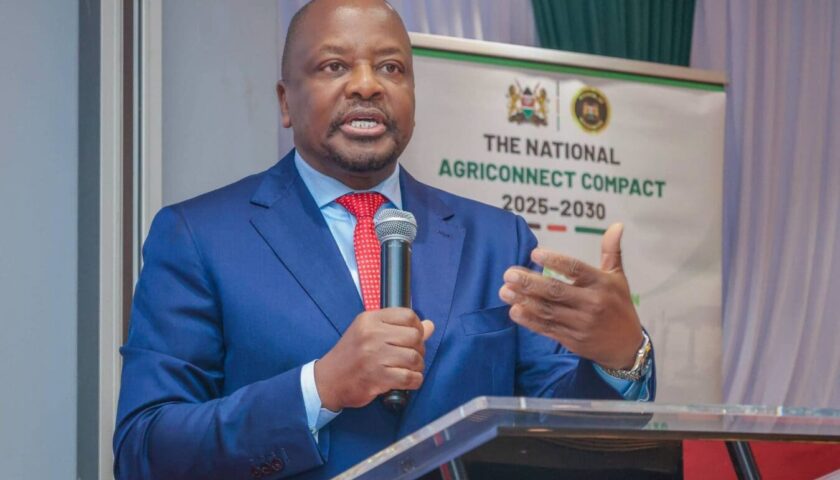
KENYA – Agriculture Cabinet Secretary Mutahi Kagwe has officially unveiled the Kenya AgriConnect Compact (2025–2030), a bold five-year roadmap designed to shift the nation’s agricultural sector from subsistence farming into a modern, technology-enabled, and commercially viable economic powerhouse.
The initiative positions agriculture “as a modern, technology-enabled, climate-smart, and investment-ready engine for inclusive economic transformation,” Kagwe stated at the launch.
To fuel this transition, the government is committing US$3.8 billion in catalytic public funds, strategically structured to de-risk the sector and crowd in an additional US$7.6 billion of private-sector investment.
Therefore, by leveraging public-private partnerships, blended finance, and credit guarantees, the framework fundamentally alters the risk profile of agricultural lending, making local value chains such as dairy, edible oils, and horticulture attractive targets for private capital.
At the heart of this ambitious strategy is a strong focus on digitalization and technology. The compact will deploy digital extension services, agritech platforms for market traceability, and advanced processing technologies to eliminate crippling post-harvest losses.
Kenya currently loses an estimated 40% of harvested crops annually, amounting to financial losses of up to US$500 million, according to the World Food Programme. Integrating platforms such as KIAMIS, which has already registered over 7.1 million farmers, will enable real-time agricultural intelligence and improved service delivery.
Beyond production, the framework prioritizes market systems transformation by upgrading infrastructure, rolling out digital marketplaces, and developing structured trading systems. These market reforms are designed to slash costly imports of food staples such as rice and maize by 50%, while driving a 60% surge in high-value exports to global markets.
Additionally, the compact is uniquely engineered to create 2.482 million new and upgraded jobs by 2030, absorbing youth into dignified roles across agro-processing, logistics, digital supply chains, and agribusiness management.
“The jobs to be created will be real jobs with dignity. The food security we achieve will mean that no Kenyan goes to bed hungry,” Kagwe emphasized.
With the technical groundwork complete and backing from the National Treasury, the Council of Governors, and international development partners, the government is now calling for private-sector action.
“We have the strategy, an investment framework, and political will. What we need now is private-sector action,” Kagwe concluded.
Sign up HERE to receive our email newsletters with the latest news and insights from Africa and around the world, and follow us on our WhatsApp channel for updates.