
Xinjiang invests US$95.5M in high-tech greenhouse blueberries targeting premium winter market
Net income per mu is expected to exceed US$7,200, with peak returns estimated at 10 times those of cotton and 15 times those of corn.
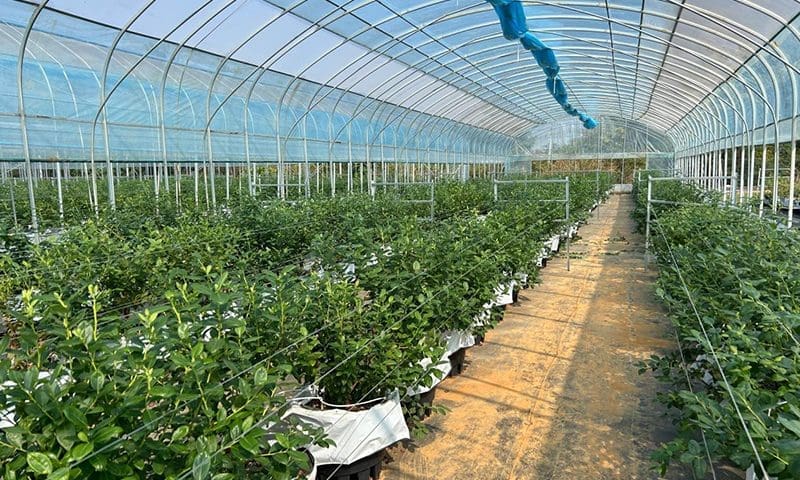
CHINA – Xinjiang is expanding its role as one of China’s key winter blueberry production hubs through a RMB 660 million (US$95.5 million) investment in high-tech greenhouse cultivation, cold chain infrastructure, and premium fruit quality positioning.
The project, developed by Xinjiang Agriculture and Animal Husbandry Investment Group in Moyu County, represents a strategic shift toward controlled environment agriculture to capture the off-season market.
The initiative centres on 300 high-tech greenhouses forming an integrated industrial chain that includes water and energy supply systems, transport infrastructure, professional grading, and cold chain logistics.
Construction began in August 2025, with planting completed in 126 greenhouses and full completion expected by March 2026. The first large-scale harvest is scheduled for November, targeting the December to April supply window when global blueberry availability is limited.
Thus, by combining protected cultivation with irrigation from Tianshan Mountain meltwater, Xinjiang producers achieve sugar content of 14% to 16% and anthocyanin levels approximately 20% higher than those of other Chinese blueberries. This demonstrates how controlled environment agriculture can overcome climatic constraints to produce premium fruit.
The profitability case is compelling. Wholesale prices for Xinjiang blueberries range from US$11.60 to US$17.40 per kilogram, while retail prices reach US$23.10 to US$34.70 per kilogram, roughly two to three times higher than conventional Chinese blueberries. Net income per mu is expected to exceed US$7,200, with peak returns estimated at 10 times those of cotton and 15 times those of corn.
The Xinjiang model demonstrates that high capital costs for protected cultivation can be justified when supply windows align with peak pricing periods.
Kateryna Zverieva, Development Director of the Ukrainian Horticultural Association, contextualized the strategic shift. “The global blueberry industry is moving increasingly toward controlled production, extended seasonal windows and premiumization. What matters more and more is not only hectares and gross output, but the ability to supply fruit at the right time, with the right quality and with minimal logistical risk. Greenhouse blueberries are becoming not merely agricultural technology, but a market strategy.”
Once fully operational, the 300 greenhouses are expected to deliver more than 1,500 tonnes of blueberries annually, with total production value estimated at RMB 120 million (US$17.4 million).
For investors across the Middle East and Africa, Xinjiang’s integration of greenhouse technology, cold chain infrastructure, and premium market positioning offers a replicable model for transforming arid-climate agriculture into high-value export industries.
Sign up HERE to receive our email newsletters with the latest news and insights from Africa and around the world, and follow us on our WhatsApp channel for updates.