Cosco Shipping Ports reports 28.5% net profit in H1 2026
AI-related investment demand contributed to a 4.8% year-on-year rise at Dalian Container Terminal to 2,695,849 TEU.
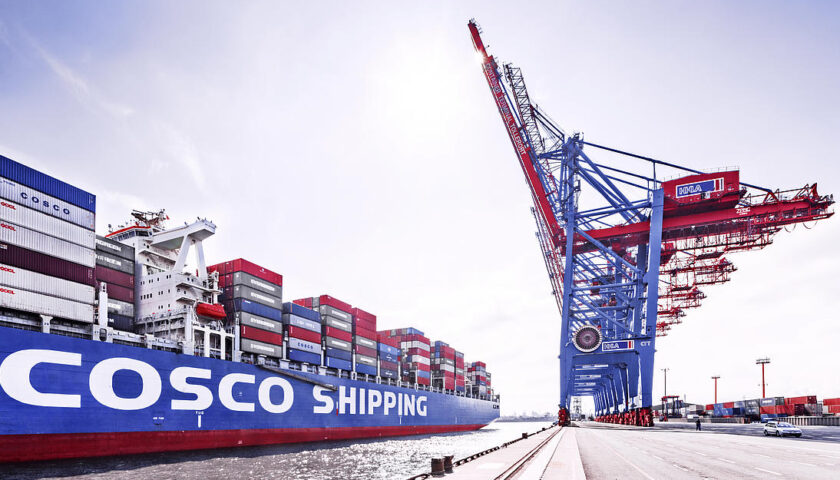
GLOBAL – Cosco Shipping Ports Limited has announced its 2026 interim results, reporting a 28.5% year-on-year increase in profit attributable to equity holders to US$233.7 million for the six months ended 30 June 2026.
Revenue grew 12.3% year-on-year to US$905.3 million, while gross profit rose 9.3% year-on-year to US$239.5 million. The company declared a first interim dividend of US$2.360 per share. Equity throughput reached 24,492,008 TEU, up 7.0% year-on-year.
Overseas terminals recorded the strongest throughput growth, up 18.0% year-on-year to 21,137,830 TEU, accounting for 26.4% of the group total.
Meanwhile, CSP Chancay Terminal in Peru reported a 68.2% year-on-year increase in total throughput to 201,773 TEU, supported by a route network comprising three main lines and five feeder lines.
Regional Performance and Geopolitical Challenges
In contrast, CSP Abu Dhabi Terminal recorded a 44.3% year-on-year decline to 442,977 TEU amid geopolitical tensions in the Middle East, while Piraeus Container Terminal recorded a 2.9% year-on-year decline to 1,995,150 TEU amid softening Mediterranean demand and adverse weather.
In China, total throughput grew 4.7% year on year to 59,019,217 TEU. CSP Wuhan Terminal recorded a 34.6% year-on-year increase in throughput to 198,577 TEU, driven by the expansion of its rail-water intermodal network along the Yangtze River.
Additionally, AI-related investment demand contributed to a 4.8% year-on-year rise at Dalian Container Terminal to 2,695,849 TEU.
Strategic Outlook and Technological Integration
Looking ahead, the company cites World Bank and IMF forecasts that project global economic growth to slow to 2.5% and 3.0% in 2026, respectively.
China’s total goods imports and exports reached RMB25.47 trillion in the first half of 2026, a 16.9% year-on-year increase, with exports up 13.4% and imports up 22.1%.
To counter future economic slowdowns, the organization intends to prioritize the integration of artificial intelligence and automation.
Moreover, the company plans to accelerate investment in emerging, regional and third-country markets, expand port-side logistics parks, and deepen the use of automation and AI across terminal operations, while reinforcing feeder network layouts to address ongoing geopolitical risks in the Middle East.
Lastly, the company is shifting its strategic focus towards emerging markets and improved logistics infrastructure to ensure long-term resilience.
Sign up HERE to receive our email newsletters with the latest news and insights from Africa and around the world, and follow us on our WhatsApp channel for updates.