
Celleste Bio unveils first chocolate-grade cocoa butter made through plant cell culture technology
The method requires only one to two beans to produce the same amount of cocoa butter that would otherwise need four tonnes of cocoa.
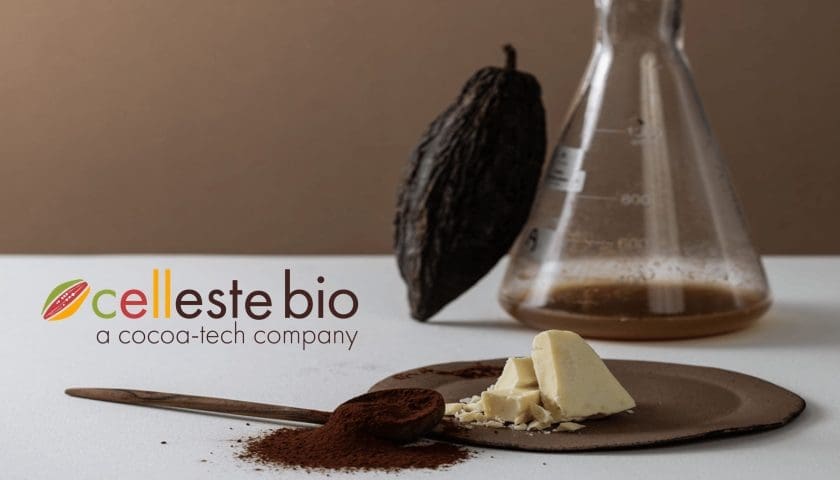
ISRAEL – Celleste Bio™, an early-stage cocoa technology company, has announced a major milestone in sustainable food innovation with the launch of its chocolate-grade cocoa butter made entirely through plant cell culture technology.
This milestone represents a major shift for the global chocolate industry, introducing a bio-identical cocoa butter that is chemically and functionally equivalent to the traditional variety but created without relying on cocoa bean farming.
Using proprietary biotechnology, Celleste Bio produces real cocoa ingredients that replicate the fatty acid composition, texture, melting point, and signature “snap” of natural cocoa butter.
The process is fully scalable, ensures consistent quality, and operates year-round, free from agricultural limitations and volatile weather patterns.
Moreover, it generates zero waste by using all inputs efficiently throughout production.
“Our ability to produce real cocoa butter via cell culture proves that science can grow ingredients that mirror nature with integrity and transparency,” said CEO Michal Berresi Golomb.
She credited CTO Dr. Hanne Volpin and the research team for their scientific breakthrough, noting that this innovation validates the cocoa industry’s efforts to find sustainable and resilient supply solutions.
Cocoa is among the world’s most valuable agricultural commodities, with chocolate manufacturers spending about US$16 billion annually on cocoa ingredients, nearly half of which goes to cocoa butter.
In 2024, global cocoa prices rose by 400 per cent due to a half-billion-ton shortage caused by climate-related crop failures, disease, and reduced yields.
Experts have warned that this volatility may become a permanent feature of the market, underscoring the urgent need for stable and scalable alternatives.
How cell-based cocoa butter is made
Celleste Bio’s process begins with the extraction of real cocoa cells from selected bean varieties, which are then cultivated in a bioreactor using a nutrient-rich mix of water, sugar, vitamins, and minerals.
Over time, the cells multiply, forming biomass from which cocoa butter and powder are extracted.
The method requires only one to two beans to produce the same amount of cocoa butter that would otherwise need four tonnes of cocoa and 10,000 square meters of land.
Notably, the cells continue growing even after biomass extraction, eliminating the need for new beans and preventing further deforestation.
According to Howard Yano Shapiro, retired Chief Agriculture Officer at Mars, Inc., innovations like Celleste’s don’t replace traditional farming but rather act as “an insurance policy against long-term supply chain disruptions.”
He emphasized that cocoa butter is the most critical and resource-intensive ingredient in chocolate, and supplementing crop-based production with biotechnology will be key to future stability.
Celleste Bio is now constructing a pilot facility to scale production, with plans to reach a 1,000-litre fermentation capacity and become market-ready by 2027.
To date, the company has raised US$5.6 million, backed by Mondelēz International as a strategic design partner and investors such as Supply Change Capital, Trendlines, and Barrel Ventures.
Founded in 2022, Celleste Bio merges biotechnology, agtech, and artificial intelligence to create a sustainable and economically viable cocoa supply, offering the chocolate industry a pathway toward long-term resilience in the face of climate and market instability.
Sign up HERE to receive our email newsletters with the latest news and insights from Africa and around the world, and follow us on our WhatsApp channel for updates.