
The Quiet Revolution Underfoot: How Precision Agriculture is Reshaping African Farming
From Guesswork to GPS: A New Dawn for African Soil
For a long time, African farmers have looked to the sky and hoped. Will rains come? Will dry spells wither maize? This uncertainty is the cruelest enemy. When you cannot predict, you overcompensate, pouring on expensive fertilizer and spraying pesticides edge to edge. That’s farming by intuition, and it’s breathtakingly wasteful.
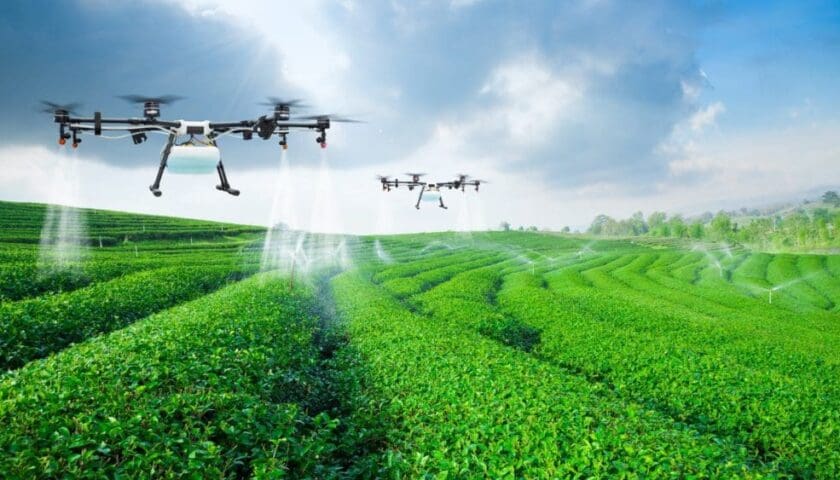
But a quiet revolution stirs beneath our feet: precision agriculture. It treats each plant as an individual, arming farmers with data instead of doubt. Using GPS, satellite imagery, soil sensors, drones, and AI, it measures exactly what a crop needs, where and when. The result? Slashed costs, boosted yields, protected water, and real money back in farmers’ pockets.
Consider the numbers: MarketsandMarkets valued the global precision agriculture market at US$11.4 billion in 2025, projected to reach US$17.9 billion by 2030, growing at 9.5% annually. For Africa, where agriculture is roughly 15% of GDP and over 60% of employment, this isn’t a luxury. It is a survival tool.
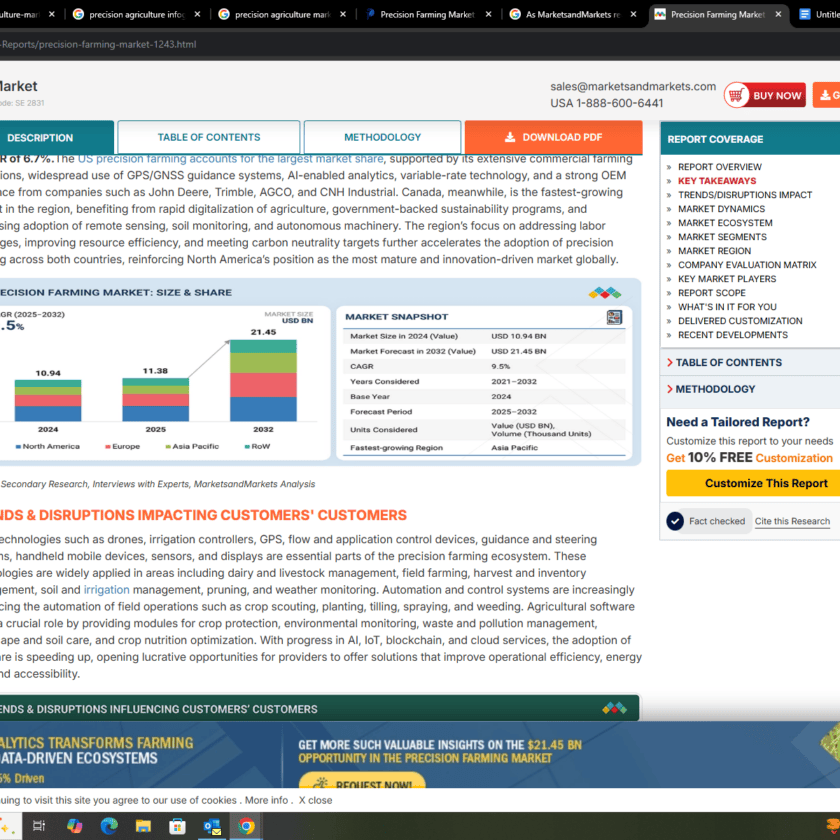
Figure: Global Precision Agriculture Market Outlook 2025-2030 Source: MarketsandMarkets
Why This Matters for African Agribusiness
The waste of traditional methods is staggering. The Food and Agriculture Organization (FAO) estimates that up to 40% of global crop yields are lost annually to pests and diseases. Even worse, when farmers do manage to apply inputs, up to 70% of applied nitrogen fertilizer is lost to the environment, washing away money and polluting rivers and groundwater.
Precision agriculture attacks this waste at its source. Variable rate technology (VRT) allows a farmer to pour more fertilizer where soil is poor and less where it is rich. A landmark study by the International Maize and Wheat Improvement Center found that precision nitrogen management in maize could reduce fertilizer use by a stunning 30% without any loss in yield. Across millions of hectares, that translates to millions of dollars saved and a significantly lighter environmental footprint.
The business case is compelling. And across Africa, innovative companies are proving it every single day.
Precision Agriculture Takes Root Across Africa
Aerobotics, a South African agritech darling, uses drone AI to help fruit farmers monitor every tree. It now manages over 50 million trees across 18 countries.
Head east to Kenya: SunCulture tackles water scarcity with solar-powered irrigation and smart soil sensors. The result? Yield increases up to 300% using a fraction of conventional water.
Then there is Twiga Foods, a Kenyan B2B platform building precision logistics. Using data analytics to predict demand and cut post-harvest losses, they connect smallholders to urban vendors. When a farmer knows their harvest won’t rot, they invest more in their land.
Cross to Egypt’s Nile Delta, where MBforTECH uses GIS and remote sensing for large-scale farm management. With Egypt relying on the Nile for over 90% of its freshwater, precision irrigation isn’t an economic choice, it’s a national necessity.
The Toolbox: Technologies Reshaping African Fields
What tools make this possible? Remote sensing: NASA and European Space Agency satellites capture every field every few days, measuring visible light, near-infrared, and thermal signatures to reveal plant health, water stress, and nutrient deficiencies before the human eye sees trouble.
GPS guidance lets a tractor steer itself with sub-inch accuracy, cutting overlaps and skips. Auto-steering reduces driver fatigue, allows night operations, and slashes input waste by 10-15% immediately.
Variable rate technology (VRT) uses digital prescription maps to adjust application rates in real time, turning fields into mosaics of micro-zones.
Soil sensors and moisture probes buried at depths transmit continuous readings on moisture, temperature, and electrical conductivity, a proxy for nutrients. Linked to irrigation controllers, they automate water delivery, giving crops exactly what they need and nothing more.
Finally, drones bridge the gap between wide-but-infrequent satellites and detailed-but-limited ground sensors.
Figure: The Precision Agriculture Framework. Source: CropIn
The Bottom Line: How Real Agribusinesses Are Profiting
Apollo Agriculture in Kenya uses machine learning and satellite imagery to provide credit and bundled inputs to smallholder farmers. By analyzing weather patterns, soil types, and historical yields, Apollo predicts which farmers are most likely to repay loans, then offers customized input packages.
Complete Farmer in Ghana operates a digital platform that connects smallholder farmers to international buyers. The company uses precision agriculture techniques, including drone monitoring and soil testing, to guarantee quality and consistency for export markets.
AgriPredict in Zambia takes a different angle, using artificial intelligence to predict pest and disease outbreaks before they occur. Farmers receive SMS alerts warning them of imminent threats, allowing for targeted preventative treatments rather than expensive, wasteful blanket spraying.
These companies prove a simple truth: precision agriculture works on African soil, for African farmers, and for African agribusinesses. They are not waiting for the future. They are building it, field by field, data point by data point.
The Stubborn Constraints (And Why They Are Falling)
No honest discussion of precision agriculture in Africa can ignore the barriers. They are real. But they are not permanent.
Cost is the most obvious obstacle. A drone equipped with a multispectral camera can cost thousands of dollars. A GPS-guided tractor with variable rate capability can cost hundreds of thousands. For the millions of African farmers who cultivate less than two hectares and earn less than two dollars a day, these price tags are absurd on the surface.
Connectivity is the second barrier. Precision agriculture generates data, but that data is useless if it cannot be transmitted to a cloud server for analysis. In rural Africa, mobile internet coverage has expanded dramatically but remains frustratingly patchy. However, technology is solving this problem faster than most anticipated.
Skills are the third barrier. Precision agriculture requires farmers who can operate digital tools, interpret data, and make decisions based on analytics rather than intuition. This is a cultural shift as much as a technical one.
Infrastructure is the fourth barrier. Precision agriculture relies on supply chains that can deliver specific inputs to specific fields at specific times. In much of rural Africa, the nearest agricultural dealer may be a day’s walk away, and the quality of available inputs is uncertain.
The Future: What Lies on the Horizon
The path forward is clear and exciting. Hardware costs are falling while software improves. Agricultural sensor costs have dropped over 90% in the past decade, mirroring computing power trends.
For agribusiness professionals across Africa, from Lagos to Nairobi, Cape Town to Accra, the message is urgent: the quiet revolution has already begun. It started not with a government announcement, but with a South African farmer flying a drone, a Kenyan father checking his phone before irrigating, and a Ghanaian cooperative using SMS for better tomato prices.
That revolution is underfoot. And it is just getting started.