

Panama Canal extends LoTSA to Panamax locks for 2027 dry season
Securing slots before the dry season removes exposure to spot auction pricing, which tends to rise as transit capacity tightens.
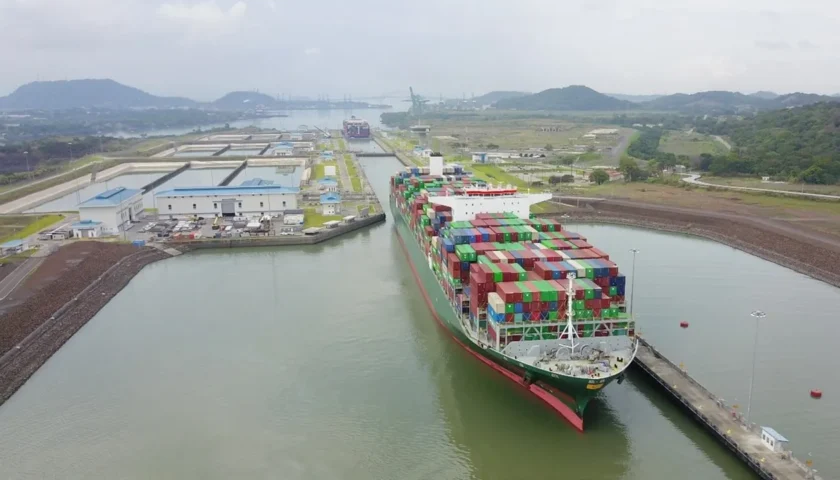
PANAMA – The Panama Canal Authority has opened bids for its Long-term Slot Allocation (LoTSA) programme covering January 3 to April 3, 2027.
The authority said it is extending the advance-booking mechanism to the Panamax locks for the first time, alongside the established Neopanamax programme.
The programme allows operators to secure transit slots months in advance during the dry season, when water availability constraints reduce daily transit capacity.
For freight forwarders, carriers and shippers moving cargo through the canal, advance slot allocation reduces schedule uncertainty on a route where draft restrictions and booking reductions have become recurring operating conditions.
Auction schedule and slot volumes
Sealed-bid competitions will be held on 17 November 2026 for the Neopanamax programme and on 24 November 2026 for the Panamax pilot.
The Neopanamax LoTSA offers 36 packages comprising 270 slots, with 165 northbound and 105 southbound, equivalent to three daily transit slots distributed across the packages.
Meanwhile, the Panamax pilot offers 51 packages totalling 288 slots, with 147 northbound and 141 southbound, equivalent to three daily transit slots across the programme period, under a single flexibility level.
The Panamax packages will use the same allocation mechanism, selection criteria and tie-breaking rules as the Neopanamax programme. Remaining capacity will continue to be offered via the regular Reservation System and Auction process.
Water availability and market implications
The programme’s expansion follows the canal’s experience of drought-driven restrictions. On August 26, 2026, the authority reduced the maximum authorized draft for Neopanamax vessels to 48 feet, then to 47.5 feet from September 3, citing declining water levels in Gatun Lake and a strengthening El Niño event.
The National Oceanic and Atmospheric Administration’s Climate Prediction Centre placed the probability of a very strong El Niño at more than 90% for the Northern Hemisphere autumn and winter of 2026-27.
Therefore, for canal users, the economic case for advance slot procurement is stronger in a restricted-capacity environment. Securing slots before the dry season removes exposure to spot auction pricing, which tends to rise as transit capacity tightens.
The canal projects 10,750 high-draft vessel transits in fiscal year 2027 and expects revenue of US$5.56 billion, with a direct treasury contribution of US$3.61 billion, according to its budget proposal.
Finally, the per-net-ton fee will increase from US$1.00 to US$1.75 per CP/SUAB ton, while the existing toll structure remains unchanged.
Sign up HERE to receive our email newsletters with the latest news and insights from Africa and around the world, and follow us on our WhatsApp channel for updates.