Published
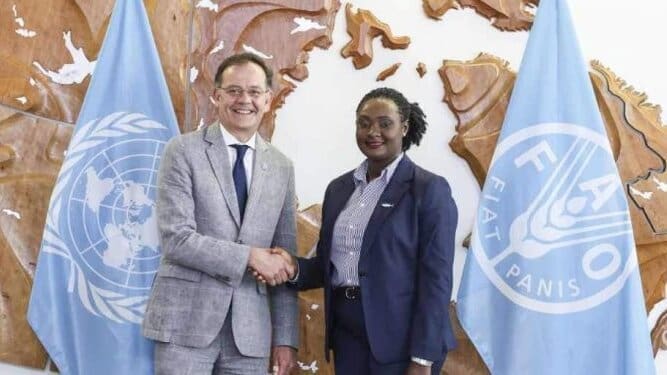
LIBERIA – The Director General of the National Fisheries and Aquaculture Authority (NaFAA) in Liberia, Madam Emma Metieh Glassco, recently engaged in a pivotal bilateral discussion with Manuel Barange, the Assistant Director General of the Food and Agriculture Organization (FAO) of the United Nations.
The meeting, which took place in Rome, Italy, during the Committee on Fisheries 36th Session (COFI 36), was focused on advancing Aquaculture (Fish Farming) Development in Liberia.
The National Fisheries and Aquaculture Authority (NaFAA) oversees the regulation of Liberia’s fisheries sector, aiming to foster growth and sustainability.
The FAO has pledged to support Liberia’s aquaculture sector, emphasizing a partnership that aims to enhance the country’s legal framework and build technical capacity.
This collaboration is expected to attract significant investment to Liberia’s fisheries sector.
The FAO’s involvement is anticipated to shift the country’s fish farming from a subsistence level to a sustainable and commercially viable industry, thereby creating job opportunities, boosting food security, and increasing the availability of fresh fish in local markets.
The primary focus will be on cultivating Tilapia and catfish.
The FAO has also committed to ensuring women’s participation in aquaculture through capacity-building initiatives, particularly in producing fish feed to support aquaculture development.
Liberia, through NaFAA, plans to submit an official request to the FAO to formalize the partnership, which will include a technical exchange program with countries like Egypt, known for their advanced aquaculture practices in Africa.
Liberia’s coastal counties, renowned for their rich fishing grounds, significantly contribute to the country’s livelihood, nutrition, and economy.
The fisheries sector accounts for approximately 10% of Liberia’s GDP and employs about 33,000 people full-time, with many more working part-time.
The sector is divided into three main components: marine fisheries, inland fisheries, and aquaculture, with artisanal and semi-artisanal coastal fisheries comprising around 86% of the country’s fisheries.
In 2020, Liberia’s artisanal fisheries yielded 18,086 tons of fish, while industrial trawlers contributed 5,113 tons.
Liked this article? Subscribe to Food Business Africa News, our regular email newsletters with the latest news insights from Africa and the World’s food and agro industry. HERE
No related posts.
We use cookies to improve your experience on our site. By using our site, you consent to cookies.
Manage your cookie preferences below:
Essential cookies enable basic functions and are necessary for the proper function of the website.
These cookies are needed for adding comments on this website.
Google's current Sign in with Google client library. It renders the Google sign-in button, or the One Tap prompt, so visitors can log in to your site with their Google account. It replaces the older Google Sign-In platform library.
Service URL: policies.google.com (opens in a new window)
Google Tag Manager simplifies the management of marketing tags on your website without code changes.
Statistics cookies collect information anonymously. This information helps us understand how visitors use our website.
Google Analytics is a powerful tool that tracks and analyzes website traffic for informed marketing decisions.
Service URL: policies.google.com (opens in a new window)
WPMU DEV Analytics is the visitor statistics feature of the WPMU DEV Dashboard plugin. It reports traffic and visitor behavior inside The Hub using a Matomo analytics instance hosted by WPMU DEV.
Service URL: wpmudev.com (opens in a new window)
Marketing cookies are used to follow visitors to websites. The intention is to show ads that are relevant and engaging to the individual user.
AddToAny provides share and follow buttons that let visitors post your pages to social networks, messaging apps, and bookmarking services.
Service URL: www.addtoany.com (opens in a new window)