
Published
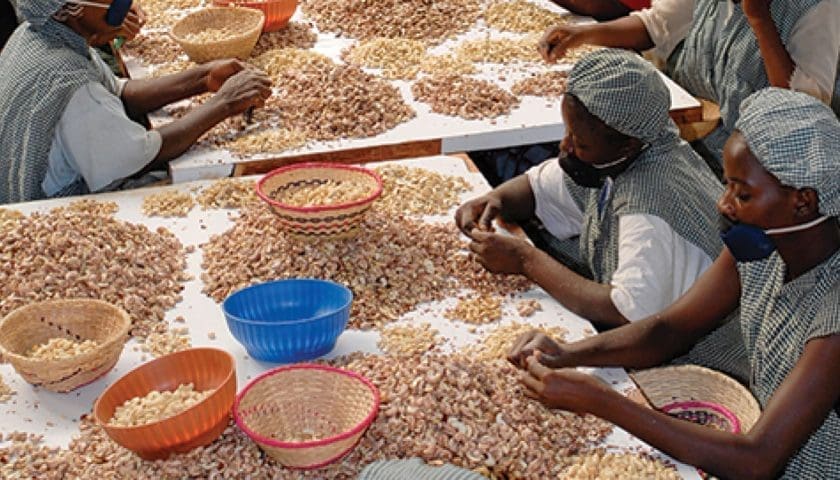
CAMEROON- The government has unveiled plans to revive the national strategy for reviving the cashew industry, targeting 100,000 hectares before 2030 with the help of the European Union (EU) and the German Cooperation Agency (GIZ).
The strategy’s target is achieving an annual production of 50,000 tons, with 50% of cashew processed locally.
According to the Cameroonian government, implementation will require investments of CFA 34.5 billion (US$56.9 million), which will be jointly provided by GIZ, the EU, and private investors.
The pilot phase of the revived program will involve setting up ten cashew processing units as farmers are encouraged to plant cashew trees. The government anticipates the processing units will generate CFA 50 billion (US$82.5 million) in annual revenue by 2030.
The plan also involves providing farmers with access to farm inputs, extension services, financial aid, and access to the market.
The strategy will particularly target the northern region, whose hot climate is suitable for cashew farming. The government revealed the plan will help the northern region diversify its economy, currently dominated by cotton.
The national strategy for growing the cashew nut value chain was initially adopted in October 2018 with the aid of the EU and GIZ. However, due to funding and management challenges, it was slow to yield results.
The revived strategy will build on the progress made in August 2023, when the Institute of Agricultural Research for Development (IRAD) distributed 25,000 cashew seedlings to 34 cooperatives in the northern region via the national strategy. This was the most significant funding for the initiative since its inception.
Although IRAD initiated a parallel project to produce a million seedlings via the same cooperatives, implementation was derailed due to limited funding and high input costs caused by disruptions in the global supply chain. The government has, therefore, been implored to ensure proper management and oversight in the implementation of the strategy.
The strategy reflects a growing interest in the growing potential of the Cameroonian agriculture sector and economy. According to the World Bank, Cameroon recorded the fastest economic growth among Central African economies from 2021 to 2023, with an average growth rate of 3.4%.
Liked this article? Subscribe to Food Business Africa News, our regular email newsletters with the latest news insights from Africa and the World’s food and agro industry. HERE
No related posts.
We use cookies to improve your experience on our site. By using our site, you consent to cookies.
Manage your cookie preferences below:
Essential cookies enable basic functions and are necessary for the proper function of the website.
These cookies are needed for adding comments on this website.
Google's current Sign in with Google client library. It renders the Google sign-in button, or the One Tap prompt, so visitors can log in to your site with their Google account. It replaces the older Google Sign-In platform library.
Service URL: policies.google.com (opens in a new window)
Google Tag Manager simplifies the management of marketing tags on your website without code changes.
Statistics cookies collect information anonymously. This information helps us understand how visitors use our website.
Google Analytics is a powerful tool that tracks and analyzes website traffic for informed marketing decisions.
Service URL: policies.google.com (opens in a new window)
WPMU DEV Analytics is the visitor statistics feature of the WPMU DEV Dashboard plugin. It reports traffic and visitor behavior inside The Hub using a Matomo analytics instance hosted by WPMU DEV.
Service URL: wpmudev.com (opens in a new window)
Marketing cookies are used to follow visitors to websites. The intention is to show ads that are relevant and engaging to the individual user.
AddToAny provides share and follow buttons that let visitors post your pages to social networks, messaging apps, and bookmarking services.
Service URL: www.addtoany.com (opens in a new window)


