

Ecuador banana exports surge 8.3% as EU, Russia drive demand
Growers report difficulty obtaining the required calibres and weights, as well as increased plant stress and phytosanitary risks.
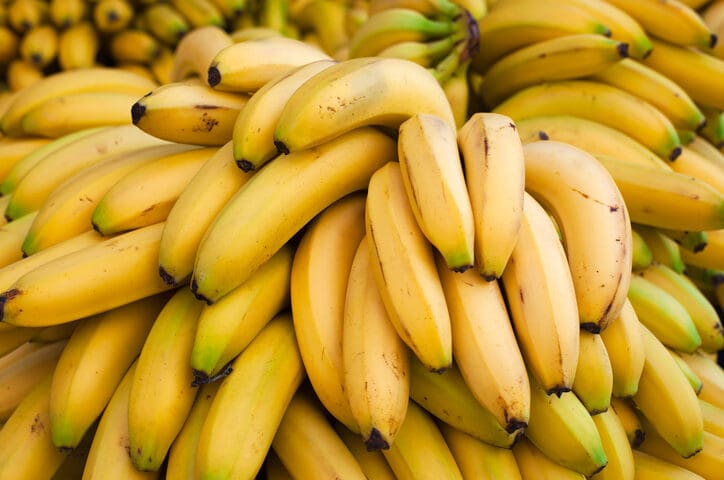
ECUADOR – Ecuador has exported 247.09 million boxes of bananas between January and July 2026, an 8.32% increase compared to the same period in 2025, driven by higher production and rising demand from major markets.
According to figures released by the Banana Exporters Association of Ecuador, this increase represents nearly 19 million additional boxes compared with the previous year.
For instance, July alone accounted for 33.67 million boxes, 19.1% more than in July 2025 and 5.25% above June’s volume.
AEBE attributes the upturn to greater supply resulting from higher temperatures in the preceding weeks. Additionally, bagging rates rose from 43.57 to 43.99 bunches per hectare, reflecting improved production conditions.
The European Union remained the leading market, receiving 81.01 million boxes, accounting for 32.78% of total exports and up 14.68% from 2025. Russia came second with 49.06 million boxes, up 11.96%, followed by the Middle East with 38.04 million boxes, up 16.93%. The Southern Cone also posted positive results with 11.67% growth.
In terms of volume, the EU contributed the most to overall growth with 10.37 million additional boxes, ahead of the Middle East with 5.51 million and Russia with 5.24 million. These three markets remain the most influential for Ecuador’s banana industry, accounting for most export volumes.
Despite the cumulative growth, AEBE notes that international demand was more uneven in July. Between weeks 27 and 30, the start of the low season and summer holidays slowed consumption and orders across several destinations, particularly in Europe.
Meanwhile, Russian demand showed a slight recovery by week 31, along with signs of renewed interest in other markets.
The association also points to pressure on the logistics chain, compounded by international competition and geopolitical tensions that continue to generate uncertainty around freight rates and supply chain costs.
In addition, growers report difficulties in obtaining the required calibers and weight, as well as greater plant stress and phytosanitary risks.
Moreover, on July 9, NOAA maintained its El Niño warning and reported a strengthening of the phenomenon, estimating a 97% probability that it will persist into the early boreal spring of 2027.
While the sector shows strong commercial momentum, it must navigate ongoing environmental and supply chain uncertainties to sustain it.
Finally, the data highlights both the opportunities and risks facing Ecuador’s banana sector, highlighting the importance of strategic planning and adaptive management in an increasingly volatile environment.
Sign up HERE to receive our email newsletters with the latest news and insights from Africa and around the world, and follow us on our WhatsApp channel for updates.