Maersk, Hapag-Lloyd return four more Gemini services to Suez Canal
The two carriers formed the Gemini network in 2025 to reduce shipping costs and improve schedule reliability.
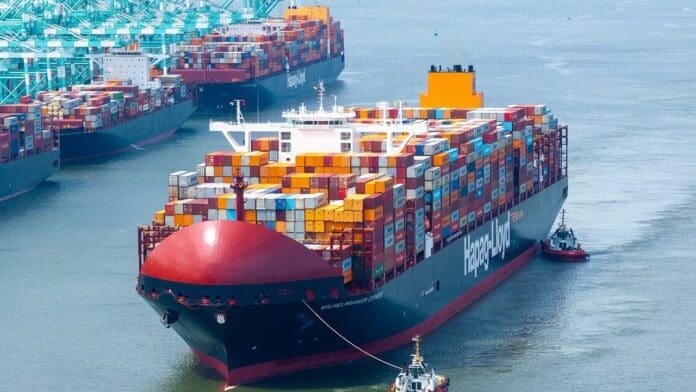
GLOBAL – Maersk has announced that four more of its joint container services with Germany’s Hapag-Lloyd will resume sailings through the Suez Canal, as the Gemini Cooperation network gradually returns to the Asia-Europe shortcut, according to a company statement.
The affected services are the AE5, AE11, AE12 and ME2, which will transition to the trans-Suez corridor instead of sailing around the Cape of Good Hope.
The Asia-Europe trade corridor through the Suez Canal was abandoned by most shippers earlier this decade after attacks in the Red Sea by Yemen’s Houthis, forcing vessels onto the longer route around Africa.
“The Suez Canal is a vital maritime corridor between East and West and a key driver of efficient global supply chains,” Maersk said. “By transitioning the AE5, AE11, AE12 and ME2 services to the trans-Suez corridor instead of sailing around the Cape of Good Hope, we will offer more efficient transit times for customers.”
Prior resumptions and security conditions
Maersk and Hapag-Lloyd announced in early July and again in August 2026 that they would resume some services linking Asia, the Mediterranean, and Europe via the Suez Canal.
The two carriers formed the Gemini network in 2025 to reduce shipping costs and improve schedule reliability. In July 2026, the partners rerouted the AE15 service via the Red Sea, with the Berlin Maersk operating the first westbound sailing.
The two companies said they will continue to closely monitor the situation in the Middle East, and any changes to their services within the Gemini cooperation network will depend on whether conflicts in the region do not escalate.
Routing context
The return to Suez follows a period when most carriers rerouted vessels around the Cape of Good Hope, adding about one to two weeks to Asia-Europe transit times.
As a result, Maersk identified shorter Asia-Europe transit times as a core operational benefit of the Suez routing.
Furthermore, the Red Sea route also reduces fuel consumption and operational costs compared with the longer Cape routing.
This shift marks a gradual normalization of Asia-Europe routings, with the Gemini Cooperation maintaining a focus on schedule reliability and safety while seeking to reduce shipping costs.
Sign up HERE to receive our email newsletters with the latest news and insights from Africa and around the world, and follow us on our WhatsApp channel for updates.