
Maersk launches Haparanda-Gothenburg block train cutting Asia transit by eight days
Three mainliner services call at Gothenburg, including direct connections to Asia.
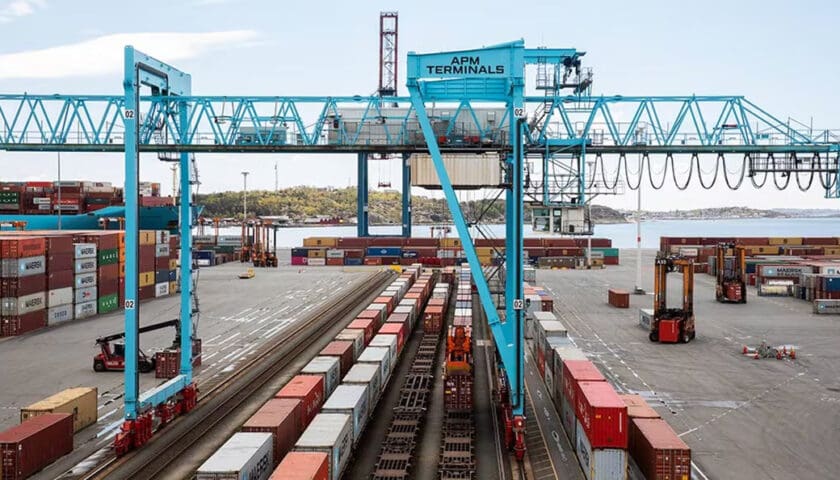
SWEDEN – Maersk has launched a block-train service between Haparanda on the Swedish-Finnish border and APM Terminals Gothenburg, offering businesses in Finland and northern Sweden a year-round gateway to global ocean networks, according to a company statement.
The first train is scheduled for 5 November 2026, with two weekly roundtrips initially. Maersk plans to increase the frequency to four, then six, weekly round trips.
Transit time and winter reliability
Compared with cargo travelling on traditional routes from Oulu in Finland to Asia, the new rail solution is expected to reduce total transit time by eight days.
In addition, customers will no longer face ice-related delays in the Northern Baltic Sea, and the rail offering bypasses port-related bottlenecks involving vessels and cranes, removing key sources of uncertainty from the transport chain.
The long-haul leg runs on electric rail, while the last mile to the customer’s door can be served by truck or rail.
Network integration and trade momentum
Through APM Terminals Gothenburg, the connection links directly to international shipping services, including Maersk’s Gemini East-West Ocean Network. Three mainliner services call at Gothenburg, including direct connections to Asia.
Kenni H.S. Callesen, Maersk Area Managing Director Nordics, said: “The new rail solution will benefit the Finnish and Swedish economies, as it will not only accelerate cargo significantly but also remove uncertainties in the transport chain, especially in wintertime.”
The launch comes as Nordic trade gains momentum. According to preliminary figures from Finnish Customs, the value of Finland’s goods exports rose 11.5% year on year in January-August 2026, with export volumes up 3.3%, while import value grew 16.6%.
In August alone, Finnish goods exports rose 22% by value and 9.5% by volume year on year. Statistics Sweden reports that Swedish goods exports rose 4% and imports 8% in January-August 2026.
Furthermore, the route serves steel, forest, pulp and paper producers on both sides of the border. For these industries, the eight-day reduction in transit time matters because it shortens working capital cycles and improves delivery reliability for Asian buyers, where predictable lead times often determine contract terms.
Lastly, the electric rail leg also reduces emissions from long-haul transport, supporting customer requirements for lower-carbon logistics on Nordic export lanes.
Sign up HERE to receive our email newsletters with the latest news and insights from Africa and around the world, and follow us on our WhatsApp channel for updates.