Saudi Arabia’s coffee trade surges as imports reach US$1.86B
The Kingdom is evolving from a major coffee importer into a regional trading and roasting hub.
SAUDI ARABIA – Saudi Arabia has reported a combined coffee and tea imports of SAR 6.99bn (US$1.86 billion) in 2025 as the Kingdom strengthens its position as both a major consumer market and an emerging regional coffee hub.
Osama Al-Awwam, co-founder and CEO of Roasting House, highlighted the scale of the transformation, noting that six countries account for 62% of Saudi Arabia’s overall coffee and tea trade.
The concentration underscores the importance of international supply relationships as domestic consumption and specialty coffee culture continue to develop.
Africa has become particularly important to Saudi Arabia’s growing coffee economy. Ethiopia is the Kingdom’s leading supplier, with imports from the East African coffee powerhouse reaching SAR 1.62bn (US$430.82m).
The flow of Ethiopian beans is helping fuel the rapid expansion of specialty coffee shops and independent micro-roasters across Saudi cities.
The trend reflects changing consumer preferences, with growing demand for premium, traceable and single-origin coffees.
As Saudi consumers become more knowledgeable about coffee origins and processing methods, established producing regions such as East Africa are gaining greater commercial significance.
However, Saudi Arabia’s role is increasingly extending beyond importing green coffee. The Kingdom is developing an export-oriented processing and roasting industry, with Egypt emerging as a significant destination for Saudi coffee shipments.
Exports to Egypt have reached SAR 115.5m (US$ 30.72m), illustrating how Saudi businesses are processing and re-exporting coffee into neighbouring Middle Eastern and North African markets.
The development is creating a regional value chain that connects African producers with Saudi roasters and consumers before extending into surrounding markets.
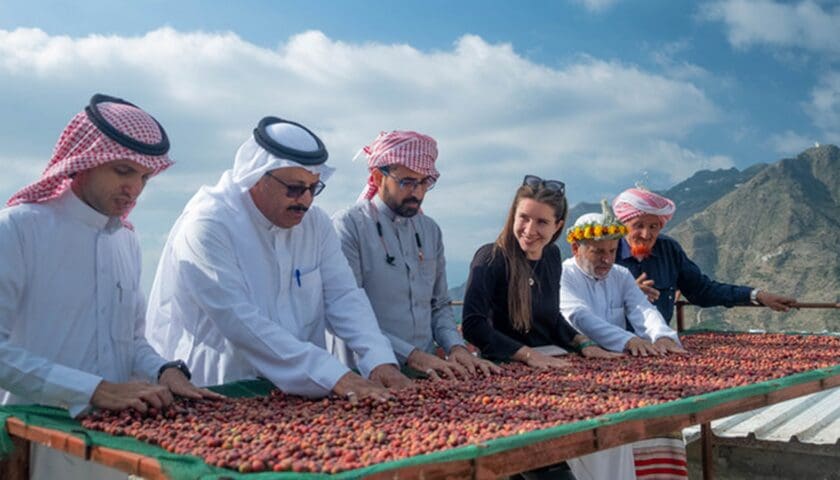
At the same time, Saudi Arabia is investing in its own coffee heritage. In Jazan’s southern highlands, farmers continue to cultivate Khawlani Arabica, a variety closely associated with the Kingdom’s agricultural and cultural identity.
Local producers are helping preserve traditional cultivation practices while bringing Saudi-grown coffee into a more commercially sophisticated market.
Roasting House’s “Farasan” coffee lot, named after the Farasan Islands off the southern coast, highlights this growing focus on domestic micro-lots and geographic identity.
Saudi Arabia’s coffee strategy mirrors wider changes across the global coffee industry, where specialty consumption, origin traceability and local roasting are reshaping traditional supply chains.
By combining large-scale imports from leading African producers with domestic cultivation, processing and regional exports, Saudi Arabia is positioning itself as a sophisticated coffee trading and consumption hub.
The result is an increasingly integrated market where international supply, local heritage and regional commerce are converging to reshape the Kingdom’s coffee economy.
Sign up HERE to receive our email newsletters with the latest news and insights from Africa and around the world, and follow us on our WhatsApp channel for updates.