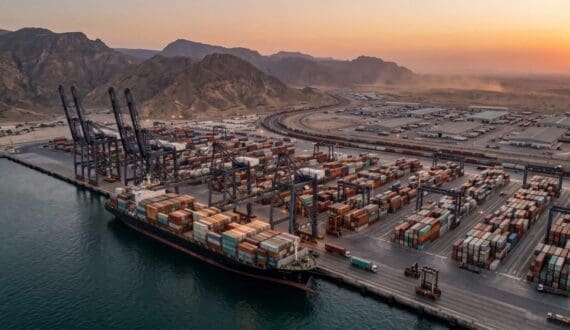

Jeddah Islamic Port sets record 582,900 TEUs in October
Total cargo handled at Saudi ports fell 11.7% to 22.36 million tons from 25.32 million tons.
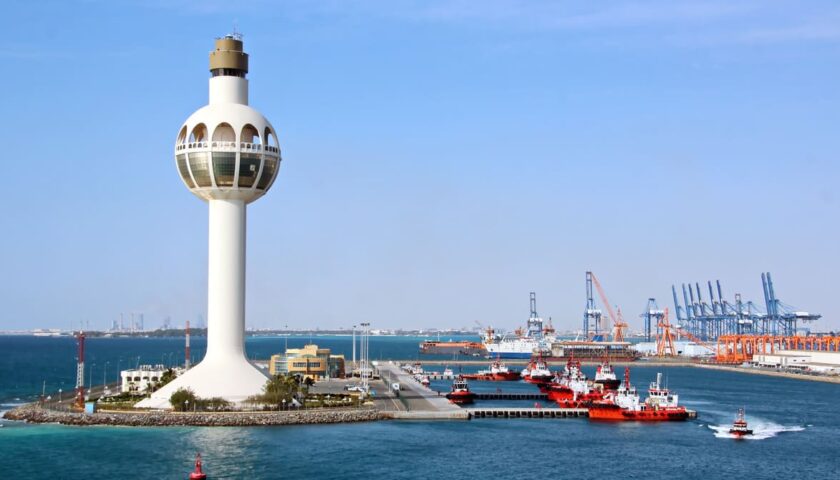
SAUDI ARABIA – Saudi ports have seen container handling rise 14% year on year in October 2026 to about 866,200 TEUs from 759,800 TEUs, according to Abdullah Al-Munif, spokesperson for the Saudi Ports Authority.
Jeddah Islamic Port recorded its highest monthly container volume at 582,900 TEUs, a 27.45% increase over its previous record set in June 2026.
Al-Munif said the performance reflects the port’s operational efficiency and its ability to accommodate growing trade volumes, thereby supporting smooth goods flow and supply chain continuity.
Container growth against falling cargo tonnage
The growth was driven by an 8.53% increase in inbound containers to approximately 305,600 TEUs from 281,600 TEUs, and a 4.83% rise in outbound containers to 282,900 TEUs from 269,900 TEUs.
Transhipment containers declined 10.54% to approximately 186,400 TEUs from 208,400 TEUs, while transit containers totalled approximately 91,300 TEUs.
Total cargo handled at Saudi ports fell 11.7% to 22.36 million tons from 25.32 million tons, comprising 1.83 million tons of general cargo, 9.48 million tons of liquid bulk and 4.44 million tons of solid bulk cargo.
The divergence between rising container volumes and falling tonnage reflects a shift in cargo mix rather than weaker trade.
Vessel calls and volumes decline
Vessel calls fell 9.62% to about 1,500 from around 1,600, while passenger traffic fell 8.96% to about 87,600 from 96,200.
Meanwhile, vehicle numbers fell 41.46% to about 65,500 from 111,900 in October 2025.
Conversely, livestock received through the ports increased 30.98% to approximately 725,100 head from 553,600 head.
The 41.46% decline in vehicle imports and the 30.98% rise in livestock receipts indicate a reorientation of import flows rather than a uniform contraction.
Vehicle volumes had grown strongly through 2025, and the October comparison reflects a high base rather than a collapse in demand.
Transhipment’s 10.54% decline is notable because it contrasts with growth in local inbound and outbound cargo.
Transhipment volumes depend on carrier routing decisions, and the return of services to the Suez Canal in 2026 altered rotation patterns across the Red Sea, prompting some carriers to shift hub activity to other ports.
Jeddah’s record performance follows the return of Gemini Cooperation’s AE15 service to the port in August 2026 and DP World’s US$800 million expansion programme at the South Container Terminal, which increased annual capacity from 1.8 million to 4 million TEUs.
Sign up HERE to receive our email newsletters with the latest news and insights from Africa and around the world, and follow us on our WhatsApp channel for updates.