Cameroon secures US$238M IsDB loan for Douala-Bafoussam corridor
The works will cover 218 kilometres of national highways and 108 kilometres of feeder roads.
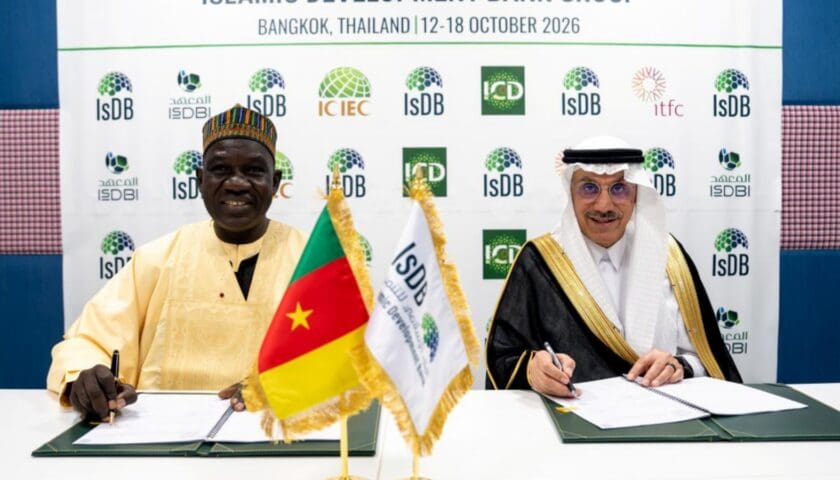
CAMEROON – The Ministry of Public Works says Cameroon has signed a €212.35 million (US$238 million) financing agreement with the Islamic Development Bank to rehabilitate the Douala-Bafoussam road corridor.
The parties signed the agreement in Bangkok on Tuesday, 13 October 2026. The project focuses on the transport route linking Douala, the country’s main port and economic hub, to the western region.
Project scope and trade impact
The works will cover 218 kilometres of national highways and 108 kilometres of feeder roads. The project also funds social and economic infrastructure, including classrooms, health centres, water supply facilities, markets and agricultural equipment.
The Douala-Bafoussam corridor links the Port of Douala to Cameroon’s western highlands, a key agricultural zone for maize, beans, potatoes and vegetables.
Improved road conditions reduce transport costs for farmers moving produce to urban markets and for exporters routing goods through Douala to regional and international destinations.
Moreover, Douala handles most of Cameroon’s external trade and serves as the primary transit gateway for the landlocked Chad and the Central African Republic.
Corridor improvements therefore extend beyond domestic freight, potentially reducing transit times for Chadian and Central African cargo passing through Cameroonian territory.
For logistics operators, the economic case hinges on whether road rehabilitation translates into lower freight rates.
For instance, in markets where trucking is fragmented and informal checkpoints add to costs, physical road improvements alone have historically delivered only partial reductions in transport prices.
Financing history and execution constraints
Since Cameroon joined the Islamic Development Bank in 1977, the institution has approved a cumulative US$4.22 billion in financing for the country, with an active portfolio spanning transport, energy and agriculture.
The project forms part of Cameroon’s broader road expansion programme. According to the Ministry of Public Works’ 2023-2025 performance review, Cameroon built about 1,006 kilometres of paved roads, meeting 97.18% of its construction target.
In addition, the government rehabilitated 2,837 kilometers against a target of 3,825 kilometers, a physical completion rate of 74.18%.
Financial execution, however, stood at about 27% of allocated funds, revealing a substantial gap between reported physical progress and budget utilization.
Finally, the agreement follows Cameroon’s October 2026 authorization of a €347.5 million World Bank loan for the Douala-Bangui corridor, highlighting a pattern of multilateral financing for the country’s trade routes.
Sign up HERE to receive our email newsletters with the latest news and insights from Africa and around the world, and follow us on our WhatsApp channel for updates.