
Published
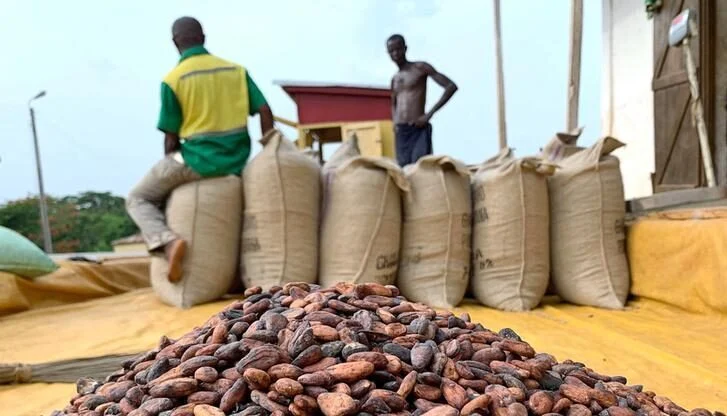
GHANA– Data from COCOBOD, Ghana’s cocoa regulator has revealed the country’s cocoa production has reached 429,323 tons so far in the 2023/2024 season, which is less than 55% of the average seasonal output with harvesting almost complete.
The poor harvests reflect the ongoing supply challenges facing the cocoa market.
Ghana’s annual cocoa production has averaged 800,000 tons in the past 5 seasons, including a 2020/2021 peak of 1 million tons according to data by the International Cocoa Organization (ICCO). However, COCOBOD recorded 3 successive seasons of decline– 683,270 tons for the 2021/2022 season and 656,140 tons for the 2022/2023 season.
The current production data from COCOBOD reveals the 2023/2024 season is the worst in terms of production in the past 10 years. In June, the Board announced it will delay the delivery of up to 350,000 tons of the crop to next season because of these supply chain issues.
Poor harvests in Ivory Coast and Ghana, the world’s largest cocoa producers, have significantly increased cocoa prices in the 2023/2024 season. The two countries contribute 60% of the total global supply.
Cocoa production in the two countries have been significantly affected by adverse weather and disease. Ghana has been particularly affected by illegal mining and cocoa bean smuggling to neighboring countries, inhibiting formal supply to the market.
The Ghana Civil Society Cocoa Platform has implored on the government to put in place policies and practices that would mitigate the effects of these Ghana-specific challenges.
Nana Kwesi Barning, Ghana Civil Society Cocoa Platform’s coordinator, said, “Galamsey and CSSVD are massive in there, especially the galamsey, per our analysis. If galamsey continues to exist, cocoa has no future. Because of the galamsey, you will not get anybody to work on the cocoa farm.”
Insecurity caused by illegal mining and smuggling has significantly hindered farming and output. Barning reiterated that many farmers in the North West and South West regions along the border with Togo and the Ivory Coast abandoned their farms because of insecurity, significantly reducing production over the last three seasons.
However, there is hope for the market after COCOBOD recently announced it expects production to rebound to 800,000 tons in the 2024/2025 season.
Sign up to receive our email newsletters with the latest news updates and insights from Africa and the World HERE.
No related posts.
We use cookies to improve your experience on our site. By using our site, you consent to cookies.
Manage your cookie preferences below:
Essential cookies enable basic functions and are necessary for the proper function of the website.
These cookies are needed for adding comments on this website.
Google's current Sign in with Google client library. It renders the Google sign-in button, or the One Tap prompt, so visitors can log in to your site with their Google account. It replaces the older Google Sign-In platform library.
Service URL: policies.google.com (opens in a new window)
Google Tag Manager simplifies the management of marketing tags on your website without code changes.
Statistics cookies collect information anonymously. This information helps us understand how visitors use our website.
Google Analytics is a powerful tool that tracks and analyzes website traffic for informed marketing decisions.
Service URL: policies.google.com (opens in a new window)
WPMU DEV Analytics is the visitor statistics feature of the WPMU DEV Dashboard plugin. It reports traffic and visitor behavior inside The Hub using a Matomo analytics instance hosted by WPMU DEV.
Service URL: wpmudev.com (opens in a new window)
Marketing cookies are used to follow visitors to websites. The intention is to show ads that are relevant and engaging to the individual user.
AddToAny provides share and follow buttons that let visitors post your pages to social networks, messaging apps, and bookmarking services.
Service URL: www.addtoany.com (opens in a new window)