
Kenya Airways reports 9% revenue growth in H1 2026
Compounding the elevated fuel costs were severe global supply-chain bottlenecks and aircraft availability constraints.
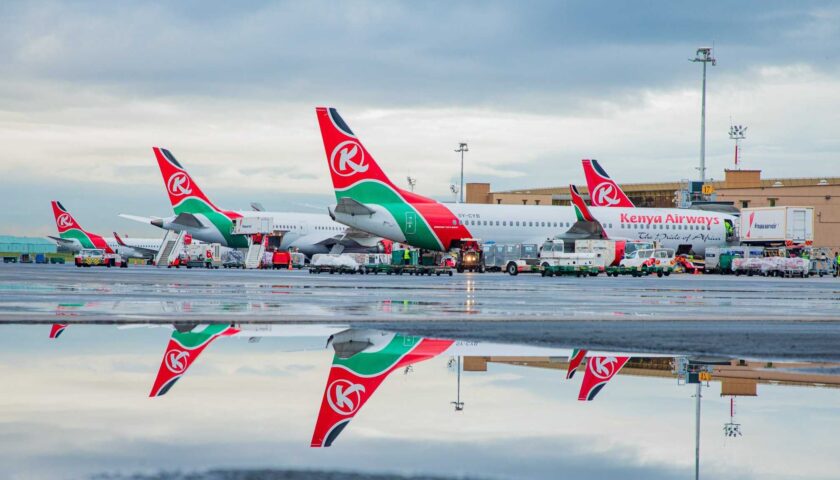
KENYA – Kenya Airways has delivered a mixed financial performance in the first half of 2026, recording a 9% increase in total revenue to KSh 81.25 billion (approx. US$627 million), a strong 18% expansion in its cargo division, and a loss after tax of KSh 16.1 billion (approx. US$124 million).
The cargo segment generated KSh 8.77 billion (US$67.7 million) in revenue, up from KSh 7.46 billion (US$57.6 million) in the prior period. The 18% year-on-year growth reflects the carrier’s deliberate commercial focus on expanding freight operations across regional and international routes.
To capitalize on this momentum, Kenya Airways has pursued additional Boeing 747 Freighter capacity, aiming to increase its cargo market share from 11% to 40%.
Meanwhile, total operating costs rose 14% to KSh 91.90 billion (US$710 million), pushing the group into an operating loss of KSh 10.64 billion (US$82 million). The primary driver was a global surge in jet fuel prices.
Fuel Cost Pressures and Operational Challenges
Global jet fuel prices surged 66% year-on-year, averaging US$142 per barrel, with extreme spikes reaching US$213 per barrel during March and April 2026. For Kenya Airways, jet fuel costs jumped 32% year-on-year, consuming approximately 32% of total operating expenses and 52% of direct operating costs.
Compounding the elevated fuel costs were severe global supply-chain bottlenecks and aircraft availability constraints.
For instance, grounding issues and engine turnaround delays lasting between 90 days and 120 days restricted fleet deployment, causing total Available Seat Kilometres to fall by 9% and total block hours to drop by 8%.
Commercial Efficiency and Recovery Strategy
Despite these challenges, commercial efficiency remained high. The passenger cabin factor improved by nearly four percentage points to 76.3%, supported by strong average coupon values and high fleet utilization rates.
Kenya Airways achieved the third-highest global utilization rates for its Boeing 787 and Boeing 737 fleets and the highest in the world for its Embraer E190 aircraft.
Looking ahead, Kenya Airways management is prioritizing fleet restoration, cost reduction, liquidity preservation, and a strategic capital raise to stabilize its financial foundation.
The carrier has already begun reintroducing key widebody aircraft, including a Boeing 787-8 in mid-July 2026 and a Boeing 777-300ER, to restore capacity and bolster operational flexibility across its international network.
Finally, by prioritizing network flexibility and loyalty program expansion, the carrier aims to move beyond its current operational hurdles toward a sustainable future.
Sign up HERE to receive our email newsletters with the latest news and insights from Africa and around the world, and follow us on our WhatsApp channel for updates.