Middle East becomes trade interconnector as South-South trade hits US$6.8T, DP World reports
UNCTAD estimates cited in the whitepaper indicate that merchandise exports among developing economies grew from about US$0.5 trillion in 1995 to US$6.8 trillion in 2025.
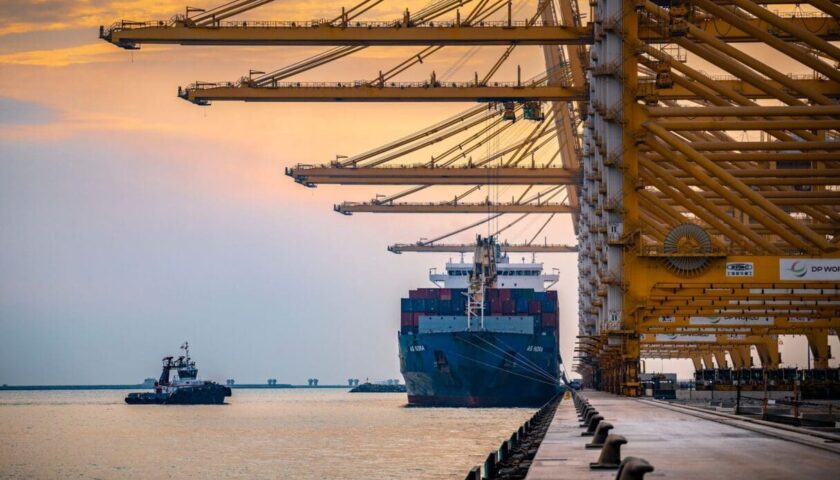
GLOBAL – The Middle East has become a trade interconnector as South-South trade reached US$6.8 trillion in 2025, and maritime trade is shifting toward resilient, integrated networks, according to a DP World whitepaper, Navigating the Future of Maritime Trade.
The whitepaper reports that the maritime system accounts for more than 80% of world merchandise trade by volume and transports an estimated US$14 trillion in containerized goods.
The Middle East, particularly the Gulf region, is positioning itself as a high-capacity interconnector linking Asia, Africa, and Europe.
Connected Trade Corridors
The report identifies a shift toward “Connected Trade Corridors,” integrated ecosystems that combine deep-sea shipping, shortsea feeder networks, ports, inland transport, and digital intelligence.
In 2026, DP World activated alternative UAE gateways at Khorfakkan and Fujairah while maintaining Jebel Ali as the primary commercial and customs hub.
Inland bonded transport, an expanded regional trucking fleet of 700 vehicles that creates capacity for up to 35,000 additional trips per month, and enhanced rail links supported it.
In addition, similar cross-border corridors linking Jeddah to the GCC, Asia to the GCC via Oman, and Europe to the Gulf through Türkiye reflect efforts to anchor the Middle East’s logistics network with flexible routing.
South-South trade growth
UNCTAD estimates cited in the whitepaper indicate that merchandise exports among developing economies grew from about US$0.5 trillion in 1995 to US$6.8 trillion in 2025, with about 57% of developing-country exports now destined for other developing markets.
Meanwhile, Chinese exports to Africa totaled US$225 billion in 2025, while imports from Africa amounted to US$123 billion, supported by tariff-free market access for 53 African nations.
AI and digital coordination
Research from DP World’s Global Trade Observatory, cited in the whitepaper, indicates that 95% of supply chain and logistics executives use artificial intelligence in some part of their operations.
Executives cited better transport connectivity (36%), improved customs procedures (35%), and avoiding geopolitical chokepoints (27%) as key drivers for re-evaluating supply chain routes.
Moreover, digital platforms, including the India-UAE MAITRI platform and the Virtual Trade Corridor, are laying the groundwork for cross-border data exchanges across the India-Middle East-Europe Economic Corridor.
Finally, DP World’s 2026 Global Trade Observatory Annual Outlook Report indicates that 94% of more than 3,500 surveyed supply chain and logistics executives expect 2026 trade growth to match or exceed 2025 levels.
Sign up HERE to receive our email newsletters with the latest news and insights from Africa and around the world, and follow us on our WhatsApp channel for updates.