Peru, Thailand sign FTA raising tariff coverage to 94%
In 2025, 93 micro, small and medium-sized enterprises accounted for 40.1% of exporters to Thailand but only 9.6% of the shipment value, according to the data.
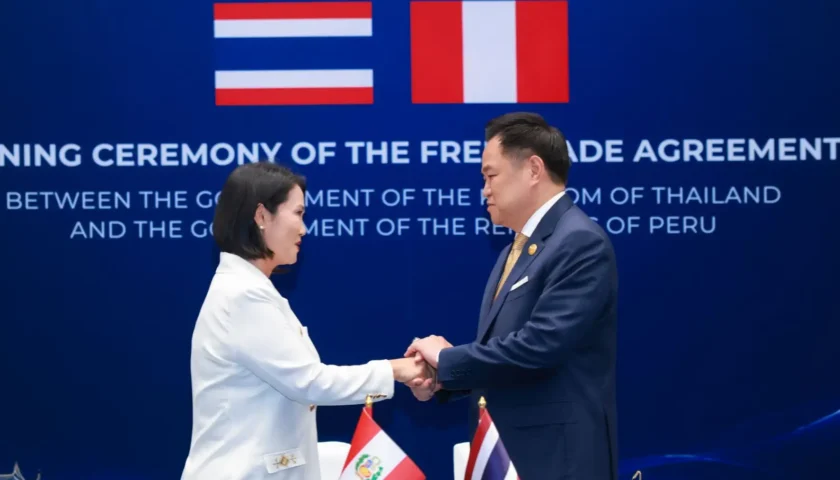
PERU – Peru and Thailand have signed a Free Trade Agreement at APEC 2026 in Shenzhen, China, which, once implemented, will raise preferential tariff coverage from 66% to 94%, according to Peru’s Ministry of Foreign Trade and Tourism.
Peruvian exports to Thailand totalled US$119.2 million in 2025, including US$12.5 million in fresh blueberries, while imports from Thailand reached US$619.7 million.
Erick Anticona, a logistics specialist at Universidad del Pacífico, identifies maritime connectivity and transport costs as barriers to export expansion.
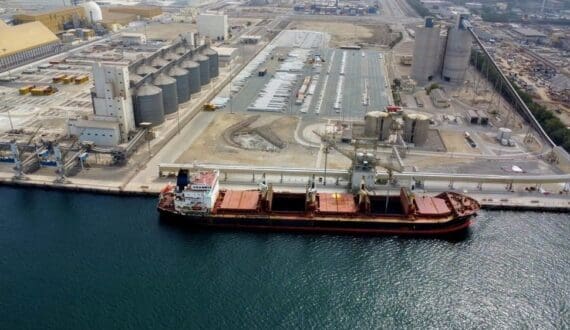
For instance, shipments from Callao and Chancay to Thailand’s Laem Chabang port require transhipment at Asian ports such as Shanghai, Busan or Hong Kong.
“The transhipment factor adds time and costs to Peruvian exports,” Anticona says.
For perishable shipments, the constraint is physical rather than administrative. Refrigerated containers, temperature monitoring and traceability are required throughout transit, and each transhipment point adds handling, delay and the risk of cold-chain failure.
Blueberries, which already account for a significant share of Peru’s exports to Thailand, are among the most sensitive to such interruptions.
Anticona proposes consolidating cargo at Chancay, including shipments from Chile, Ecuador, Colombia and Argentina, to achieve higher volumes and more competitive transport conditions to Asia.
That approach would position Peru’s port infrastructure as a regional aggregation hub rather than a national export gateway, improving frequency and reducing per-container costs for all users.
In 2025, 93 micro, small and medium-sized enterprises accounted for 40.1% of exporters to Thailand but only 9.6% of the shipment value, according to the data.
These firms incur the same transhipment costs as larger exporters but have less capacity to absorb them.
Meanwhile, Anticona calls for shared logistics services, cargo consolidation and a registry of small businesses interested in exporting to Thailand to facilitate coordination and joint negotiation with logistics operators.
Additional priorities include improving land access to the port of Chancay, simplifying customs procedures, expanding digital certification through the Single Window for Foreign Trade, and diversifying the export portfolio beyond blueberries into other productive sectors.
“The biggest challenge will be to incorporate small and medium-sized enterprises into these export chains, reducing logistics costs and strengthening their operational capabilities to compete sustainably in Southeast Asia,” Anticona says.
Ultimately, for the FTA to deliver on its tariff ambitions, the logistics and administrative gaps must be closed first; otherwise, the benefits will accrue to exporters already large enough to navigate the complexity.
Sign up HERE to receive our email newsletters with the latest news and insights from Africa and around the world, and follow us on our WhatsApp channel for updates.