
Benin secures US$364.4M from Islamic Development Bank for road, agriculture projects
The project aims to improve soil fertility, strengthen food security, and help farms withstand climate change.
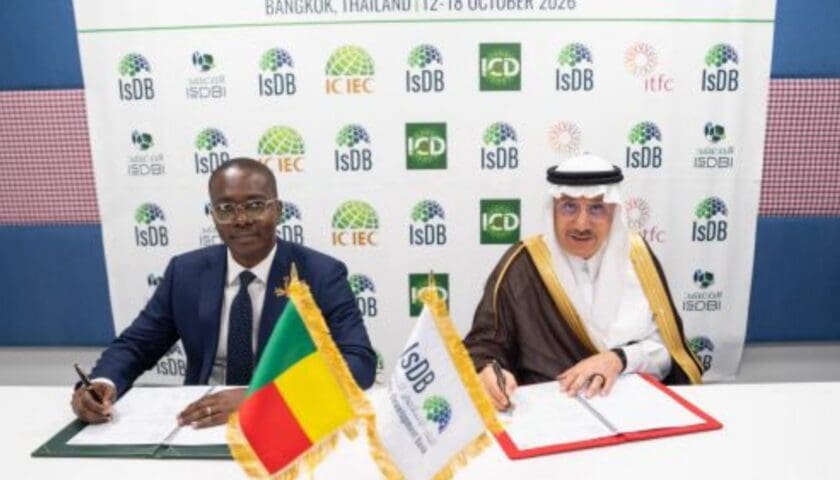
BENIN – Benin has signed two cofinancing agreements with the Islamic Development Bank (IsDB) worth a combined €326.06 million (US$364.4 million) to upgrade the Godomey-Ouidah-Hillacondji road and to improve agricultural productivity, food security and climate resilience, according to the IsDB.
The agreements were signed in Bangkok on Monday, October 12, on the sidelines of the annual meetings of the World Bank Group and the International Monetary Fund.
This followed talks between IsDB Group President Muhammad Al Jasser and Benin’s Minister Delegate for External Resource Mobilization and Public Debt Management, Hugues Oscar Lokossou.
The first agreement provides €306.89 million (US$343 million) to widen and upgrade the Godomey-Ouidah-Hillacondji road, a project estimated to cost €576.06 million.
The work aims to improve road safety and traffic flow, reduce travel times and transport costs, and facilitate trade along the Abidjan-Lagos corridor.
For agricultural exporters, road quality along this corridor directly affects the cost and reliability of transporting perishable goods to ports and regional markets.
Benin has increased investment in road improvements in recent years, approving a programme in October 2026 to rehabilitate nearly 18,000 km of rural tracks and unpaved roads in 2026-2027.
Moreover, several major projects are underway or in planning, including work on the Cotonou-Niamey corridor to improve freight transport between production areas, commercial centres and regional markets.
The second agreement provides €19.17 million (US$21.4 million) in IsDB financing for a €20.70 million project, supporting efforts to make legume-based farming systems more productive and sustainable across five agricultural development zones.
The project aims to improve soil fertility, strengthen food security, and help farms withstand climate change.
Agriculture remains a major employer in Benin, accounting for 40.2% of employment in 2025, according to International Labour Organization estimates cited by the World Bank.
To support production, the government allocated CFAF 31.87 billion (US$57 million) in fertilizer subsidies for the 2026-2027 farming season, a 22% increase on the previous year.
Muhammad Al Jasser reaffirmed the IsDB’s commitment to continuing its partnership with Benin, emphasizing the importance of sustained collaboration to advance sustainable development and deliver tangible benefits to communities.
Lastly, the IsDB’s portfolio in Benin comprises 116 projects worth a combined US$1.8 billion, spanning transport infrastructure, energy, agriculture, water and sanitation, and education and health.
Sign up HERE to receive our email newsletters with the latest news and insights from Africa and around the world, and follow us on our WhatsApp channel for updates.