
Maersk completes first ethanol bunkering on retrofitted vessel in Singapore
The operation builds on earlier ethanol trials on the dual-fuel vessels Laura Maersk, Antonia Maersk and Tangier Maersk.
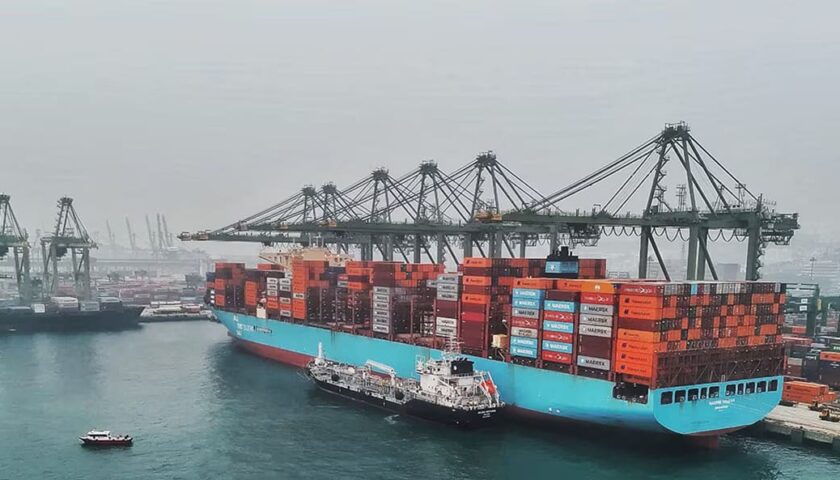
SINGAPORE – Maersk has successfully bunkered approximately 5,000 metric tonnes of ISCC-certified bioethanol on the Maersk Halifax, the company’s first retrofitted dual-fuel vessel, in Singapore, according to a company statement.
The operation marks the first time Maersk has bunkered ethanol on a retrofitted vessel in its fleet and was conducted in collaboration with the Maritime and Port Authority of Singapore and other partners.
Fuel pathway and vessel retrofit significance
Ethanol is emerging as a transition fuel because it is globally available, has established production and distribution networks, and is compatible with alcohol-enabled engine technologies.
When certified and sourced from low-carbon pathways, ethanol can deliver significant greenhouse gas reductions compared with conventional marine fuels.
Meanwhile, retrofitting is commercially important. Retrofitting existing vessels to run on alternative fuels extends the operating life of assets that would otherwise require replacement, reducing capital expenditure compared with newbuildings.
In addition, Maersk’s dual-fuel retrofit programme allows the company to test fuel pathways across a broader portion of its fleet without committing to a single fuel type.
Emma Mazhari, Head of Energy Markets at Maersk, said: “The energy transition requires us to explore and scale solutions that can deliver real-world impact. At Maersk, we continue to pursue a multi-fuel strategy because we recognize that no single fuel pathway can decarbonize global shipping on its own.”
Prior trials and comparative context
The operation builds on earlier ethanol trials on the dual-fuel vessels Laura Maersk, Antonia Maersk and Tangier Maersk.
In September 2026, Maersk completed the first ship-to-ship commercial ethanol bunkering of a deep-sea container vessel in the United States, using US-produced corn ethanol aboard the Tangier Maersk.
Maersk’s multi-fuel approach reflects the absence of a dominant alternative fuel. Methanol has attracted orders from Maersk and CMA CGM, with Maersk ordering 26 LNG dual-fuel vessels for delivery in 2029-2030.
Meanwhile, CMA CGM expects to operate around 200 dual-fuel LNG and methanol-powered vessels by 2031. Biofuel-based solutions such as CMA CGM’s ACT+ service offer near-term emissions reductions using existing vessels.
Ethanol’s advantage over methanol and ammonia lies in existing global infrastructure; ports already handle ethanol for industrial and fuel uses, whereas methanol and ammonia bunkering networks remain limited.
The Singapore operation will provide Maersk with data on supply chain readiness and vessel performance to inform whether ethanol will continue to play a role or serve as an interim measure until methanol and ammonia infrastructure matures.
Sign up HERE to receive our email newsletters with the latest news and insights from Africa and around the world, and follow us on our WhatsApp channel for updates.