
NYK, MISC joint venture signs 10-year LNG charter with Malaysia LNG
The dual-fuel diesel-electric propulsion enables operation on conventional marine fuel and alternative, lower-carbon fuels.
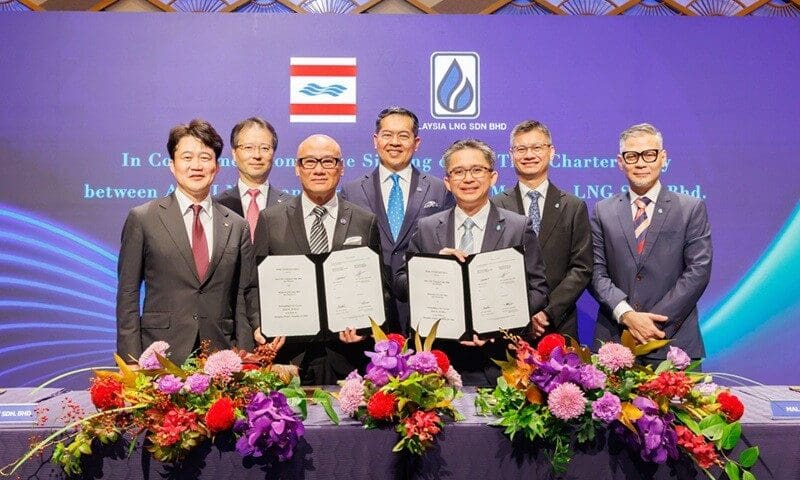
JAPAN – Asia LNG Transport, a joint venture between Japan’s Nippon Yusen Kaisha and Malaysia’s MISC Group, has signed a 10-year time-charter agreement with Malaysia LNG for a new liquefied natural gas carrier, according to a joint statement.
Hudong-Zhonghua Shipbuilding in China will build the vessel as a dual-fuel diesel-electric carrier and deliver it in 2028.
Representatives from Malaysia LNG, MISC, and NYK attended the charter signing ceremony in Tokyo on 9 October 2026.
Joint venture structure and track record
Asia LNG Transport was established in Malaysia on 23 February 1987 and is 51% owned by MISC through an indirect equity interest, with NYK holding the remaining 49%. Its principal business is owning and operating LNG carriers.
The joint venture already owns the LNG carrier Aman Sendai, which has served the Bintulu-Sendai trade route since 1998, operating for 28 years on the same Malaysia-to-Japan corridor the new vessel will serve.
That continuity matters commercially because the Bintulu-Sendai route requires reliable vessels, as Sendai’s LNG terminal supplies gas-fired power generation in northern Japan.
Roles, vessel specification and energy security
MISC is the majority partner and draws on its position within the Petronas Group, providing the joint venture with a direct commercial link to Malaysia LNG as both charterer and cargo source.
NYK, meanwhile, contributes vessel-management expertise and global LNG fleet operations, along with Japanese market relationships that highlight long-term charter demand.
The 18,700 cubic-metre vessel is notably small by contemporary LNG carrier standards, as newbuildings typically range from 170,000 to 180,000 cubic metres.
The specification indicates the vessel is designed for regional or coastal LNG distribution rather than transoceanic bulk carriage, consistent with the Malaysia-to-Japan route profile and potential secondary use for domestic Japanese distribution or small-scale terminal supply.
Additionally, the dual-fuel diesel-electric propulsion enables operation on conventional marine fuel and alternative, lower-carbon fuels.
Hironobu Watanabe, NYK senior managing executive officer, said: “We are very pleased to have concluded this charter agreement. Together with MLNG, MISC, and our other partners, we will strive to provide safe and reliable LNG transportation services and contribute to the stable supply of energy to Japan.”
Lastly, the contract extends a nearly four-decade maritime relationship between NYK and MISC on the Malaysia-Japan LNG corridor, reinforcing Japan’s long-term supply arrangements with Malaysian producers as the country continues to rely on LNG for baseload power generation.
Sign up HERE to receive our email newsletters with the latest news and insights from Africa and around the world, and follow us on our WhatsApp channel for updates.