
Nigeria, Valmont to build irrigation factory, pilot 40,000 hectares
For commercial growers and processors, the significance lies in how locally manufactured irrigation equipment could affect input costs and lead times.
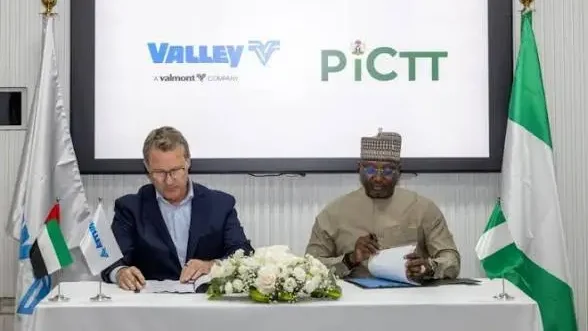
NIGERIA – Nigeria has signed a memorandum of understanding with US company Valmont Industries to build a domestic irrigation equipment factory and develop a 40,000-hectare pilot irrigation project in Adamawa State.
According to the Presidential Implementation Committee on Technology Transfer, the agreement announced on November 22 is intended to expand domestic manufacturing and reduce reliance on imported irrigation systems.
The factory would be developed in partnership with the National Agency for Science and Engineering Infrastructure to transfer technology and develop local manufacturing expertise.
Meanwhile, the pilot project will be carried out with the Nigeria Incentive-Based Risk Sharing System for Agricultural Lending and the National Agricultural Development Fund.
Officials have not disclosed the project’s estimated cost, the factory’s planned production capacity or when construction might begin.
For commercial growers and processors, the significance lies in how locally manufactured irrigation equipment could affect input costs and lead times.
Imported centre-pivot systems incur freight, currency, and delivery delays that increase the capital cost of irrigated production.
Additionally, domestic manufacturing, if it achieves scale, would shorten supply chains and make equipment procurement more predictable for large-scale row- and field-crop operations.
The proposed factory would strengthen Valmont’s manufacturing presence in Africa, where the company already operates through its Valley Irrigation brand.
Valley Irrigation had already installed more than 20,000 centre-pivot systems across Africa and established a network of 38 distributors on the continent, according to figures the company published in an August 2021 brochure.
Moreover, the proposed factory comes as Nigeria steps up irrigation investment. In November 2026, authorities launched a prequalification process for contractors to rehabilitate and modernize six irrigation schemes under the World Bank-financed Sustainable Power and Irrigation for Nigeria project.
The project was officially launched in March 2026 with US$500 million in funding to restore 40,000 hectares of irrigated farmland and support the goal of expanding the country’s irrigated area to 500,000 hectares by 2030.
Finally, Nigeria had approximately 331,150 hectares equipped for irrigation in 2023, according to the FAO, far below the 3.14 million hectares that some national estimates identify as potentially irrigable.
Sign up HERE to receive our email newsletters with the latest news and insights from Africa and around the world, and follow us on our WhatsApp channel for updates.