

DP World, H.Essers win VIL award for Zeebrugge-Barcelona rail service
DP World’s Multimodal Solutions transports palletized goods, while H.essers specializes in tank containers.
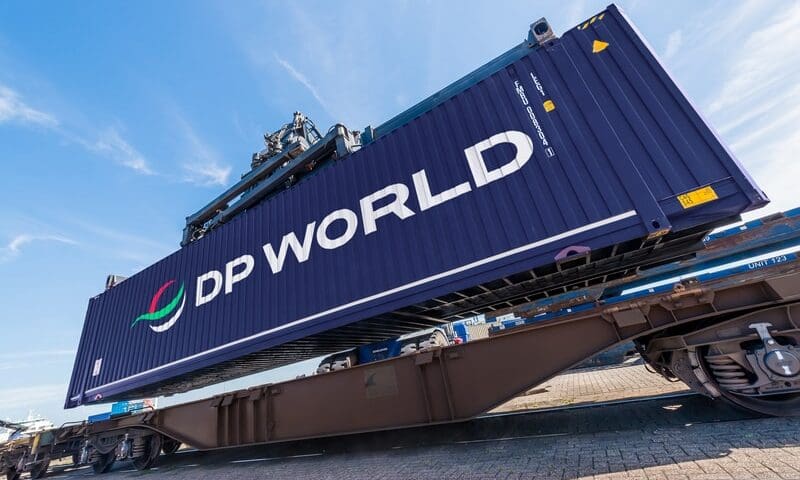
EUROPE – DP World’s Multimodal Solutions and H.Essers have jointly received the 2026 Trailblazing Logistics Service Provider Award from the Flanders Institute for Logistics for their rail freight service connecting Zeebrugge with La Llagosta near Barcelona.
The service is expected to deliver annual savings of 17,000 tonnes of tank-to-wheel CO2 emissions, a 95% reduction compared with equivalent road transport.
In addition, it is expected to eliminate approximately 7,200 truck movements and one million kilometers of road transport in Belgium each year.
Cargo combination model
Moving freight between Belgium and Spain has traditionally relied on road transport, with driver shortages and limited rail capacity creating challenges.
Meanwhile, establishing regular rail connections requires sufficient cargo volumes to make services commercially viable.
As a result, DP World and H.Essers combined their complementary freight volumes on the same corridor.
DP World’s Multimodal Solutions transports palletized goods, while H.essers specializes in tank containers.
Therefore, by bringing together cargo that would otherwise move separately, the partners generated the volumes needed to establish a regular rail service without competing for the same cargo.
Moreover, the service operates without subsidies. The 650-metre train carries up to 45 transport units, weighing 1,800 tonnes in total, and completes the journey in approximately 36 hours.
Timm Niebergall, CEO of Multimodal Solutions at DP World, said: “Making rail freight work is not just about building infrastructure. It is about bringing together the right volumes, partners and operational capabilities to create a service that customers can rely on. Our collaboration with H.Essers shows how two logistics providers can overcome shared challenges and build a commercially viable alternative to road transport.”
Service frequency and expansion
The train currently operates two round trips per week, with plans to increase to three by the end of 2026 and four in 2027.
The subsidy-free structure is the service’s most transferable element. Rail freight between Belgium and Spain has historically required public support because individual shippers cannot generate sufficient volume to fill trains on their own.
Combining palletized goods and tank containers from two operators creates the density needed to justify regular departures without state funding, and the model depends on the two cargo types remaining complementary rather than competing for the same train capacity.
Sign up HERE to receive our email newsletters with the latest news and insights from Africa and around the world, and follow us on our WhatsApp channel for updates.